AI Is Eating Software
Published: 20 Jul 2026
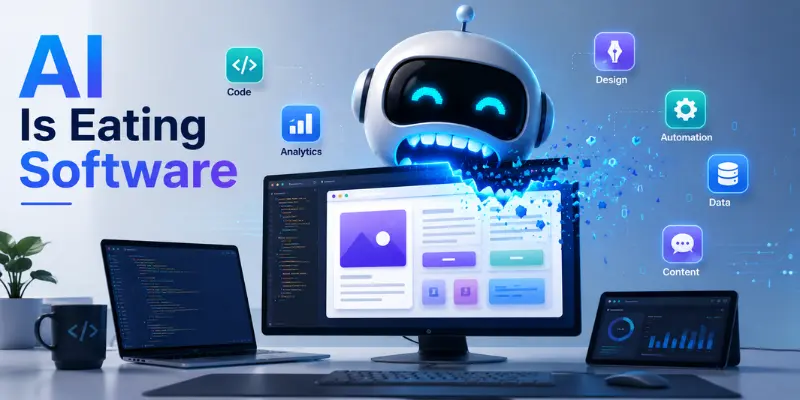
Artificial intelligence is changing the technology industry faster than ever before. As AI tools become smarter, a new phrase has started appearing in discussions about the future of technology: AI is eating software.
At first, this statement may sound confusing. Software powers websites, mobile apps, business systems, and countless digital tools. So how can AI “eat” software?
The phrase does not mean that software will disappear. Instead, it suggests that AI is changing how software is built, used, and experienced. Many tasks that once required traditional software can now be completed through AI-powered systems. Understanding this trend can help businesses, developers, and everyday users prepare for the future of technology.
Quick Answer: What Does “AI Is Eating Software” Mean?
“AI is eating software” means that artificial intelligence is becoming the main way people interact with technology. Instead of using traditional software with complex menus and settings, users can simply tell AI what they want and receive results instantly.
AI is not replacing all software. However, it is changing how software works and making many applications smarter, faster, and easier to use.
Why People Say AI Is Eating Software
The popularity of AI tools has changed the way people complete digital tasks.
In the past, users had to learn different software programs for writing, designing, coding, research, and data analysis. Today, AI can perform many of these tasks from a single interface.
This shift is one of the main reasons why experts say AI is eating software.
AI Simplifies Complex Tasks
Traditional software often requires training and technical knowledge. Users must learn menus, settings, and workflows before they can use the software effectively.
AI changes this process. Instead of learning complicated tools, users can simply describe what they need.
For example:
- Write a blog post
- Create a presentation
- Design an image
- Generate code
- Analyze data
The AI handles most of the work automatically.
Natural Language Is Becoming the New Interface
Most software relies on buttons, menus, and dashboards. AI introduces a different approach. Users can communicate with AI using everyday language.
Instead of clicking through multiple screens, a user can type:
- Create a sales report
- Summarize this document
- Generate a marketing plan
- Design a logo
This makes technology more accessible for beginners and non-technical users.
AI Automates Repetitive Work
Many business tasks follow predictable patterns.
Examples include:x
- Data entry
- Customer support
- Content creation
- Report generation
- Email responses
AI can automate these activities and reduce manual work.
As automation improves, businesses rely less on traditional software workflows and more on intelligent systems.
AI Creates Software Faster
Developers are also using AI.
Modern AI coding assistants can generate code, identify bugs, explain functions, and suggest improvements. As a result, software development becomes faster and more efficient.
This is another reason why people believe AI is transforming the software industry.
How AI Is Changing Traditional Software
AI is not affecting just one industry. It is transforming many types of software used by businesses and consumers.
Software Development
AI helps developers write code faster. Instead of building every feature manually, developers can use AI to generate code snippets, debug applications, and automate routine programming tasks.
This allows teams to focus on solving larger problems.
Customer Support
Many companies now use AI-powered chatbots. These systems answer questions, provide recommendations, and assist customers around the clock. Businesses can improve response times while reducing support costs.
Content Creation
Content creation software has changed dramatically.
AI can now help users:
- Write articles
- Generate social media posts
- Create product descriptions
- Draft emails
- Produce marketing content
This saves time and increases productivity.
Data Analysis
Businesses collect huge amounts of data. AI helps process this information quickly and identify patterns that humans might miss. Organizations can make better decisions based on these insights.
Business Operations
Companies use AI to improve many daily operations.
Examples include:
- Sales forecasting
- Inventory management
- Process automation
- Financial reporting
- Customer relationship management
These improvements help businesses operate more efficiently.
Real Examples of AI Replacing Software Tasks
AI is already performing tasks that once required separate software applications.
Writing and Content Creation
In the past, users relied entirely on writing software and manual research.
Today, AI can:
- Generate articles
- Create outlines
- Suggest headlines
- Improve grammar
- Rewrite content
Graphic Design
Design tools still exist, but AI can now create images, graphics, and marketing materials from simple text prompts.
This reduces the time needed to produce visual content.
Coding Assistance
AI coding assistants help developers write and review code.
They can:
- Generate code
- Explain functions
- Fix errors
- Suggest improvements
This speeds up software development.
Research and Information Gathering
Traditional search requires users to review multiple websites. AI can summarize information and provide direct answers more quickly.
Customer Service
AI-powered assistants can handle many support requests without human involvement. This improves efficiency and reduces workload for support teams.
Will AI Replace Traditional Software?
This is one of the most common questions people ask. The short answer is no. AI will not completely replace software. Instead, AI will become a feature inside software. Many applications will continue to exist, but they will become more intelligent and easier to use.
What AI Can Replace
AI can replace or automate:
- Repetitive tasks
- Basic content creation
- Simple customer support
- Data processing
- Routine workflows
What AI Cannot Replace
AI still struggles with:
- Complex decision-making
- Business strategy
- Human creativity
- Leadership
- Emotional intelligence
Human expertise remains important in many situations. Software will continue to play a major role in supporting these activities.
Benefits of AI-Driven Software
AI-powered software offers many advantages.
Benefits
- Faster workflows
- Improved productivity
- Reduced manual work
- Better automation
- Easier user experience
- Faster decision-making
- Lower operational costs
- Personalized recommendations
- Improved efficiency
- Greater scalability
These benefits explain why businesses are adopting AI at a rapid pace.
Challenges and Concerns
Despite its advantages, AI also presents challenges.
Challenges
- Accuracy issues
- AI hallucinations
- Privacy concerns
- Security risks
- Data quality problems
- High implementation costs
- Dependence on AI systems
- Ethical concerns
- Regulatory uncertainty
- Lack of transparency
Organizations must address these challenges to use AI responsibly.
The Future of AI and Software
The relationship between AI and software will continue to evolve. Future software will likely include AI as a core feature rather than an optional add-on. Users may interact with software primarily through conversations instead of traditional interfaces.
AI agents could complete complex tasks automatically, manage workflows, and assist users with daily activities.
Businesses are also moving toward AI-first products that place artificial intelligence at the center of the user experience. As technology advances, software will not disappear. Instead, it will become more intelligent, more automated, and easier to use.
Conclusion
The phrase “AI is eating software” reflects a major shift in the technology industry. AI is changing how people interact with digital tools and making software more intelligent than ever before.
Rather than replacing software completely, AI is transforming it. Users can now complete tasks through simple conversations, automate routine work, and access powerful capabilities without learning complex systems.
As AI continues to evolve, software will become smarter, more efficient, and more user-friendly. Businesses, developers, and consumers who understand this trend will be better prepared for the future of technology.

- Be Respectful
- Stay Relevant
- Stay Positive
- True Feedback
- Encourage Discussion
- Avoid Spamming
- No Fake News
- Don't Copy-Paste
- No Personal Attacks
- Be Respectful
- Stay Relevant
- Stay Positive
- True Feedback
- Encourage Discussion
- Avoid Spamming
- No Fake News
- Don't Copy-Paste
- No Personal Attacks
