Advantages and Disadvantages of Artificial Intelligence
Published: 19 Jul 2026
Artificial Intelligence (AI) is one of the most important technologies in the modern world. It is changing the way people work, learn, communicate, and solve problems. Today, AI is used in smartphones, search engines, online shopping, healthcare, education, banking, and many other industries.
AI can perform tasks that normally require human intelligence, such as learning, problem-solving, decision-making, and understanding language. While AI offers many benefits, it also creates challenges that people and businesses must consider.
In this article, you will learn the main advantages and disadvantages of artificial intelligence, along with real-life examples and its future impact.
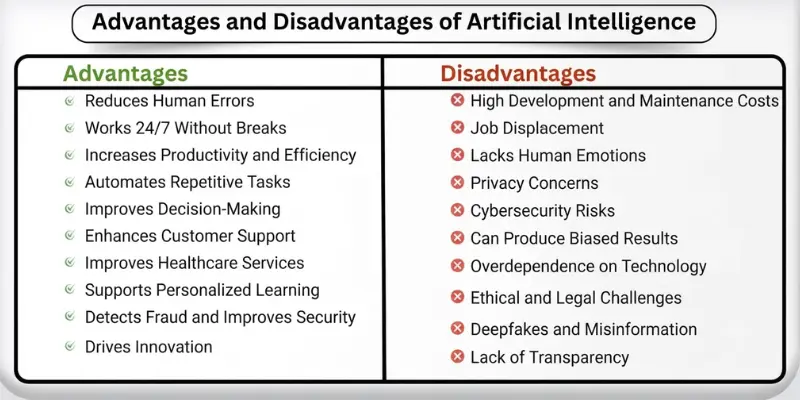
Advantages of Artificial Intelligence
Here are some benefits of AI
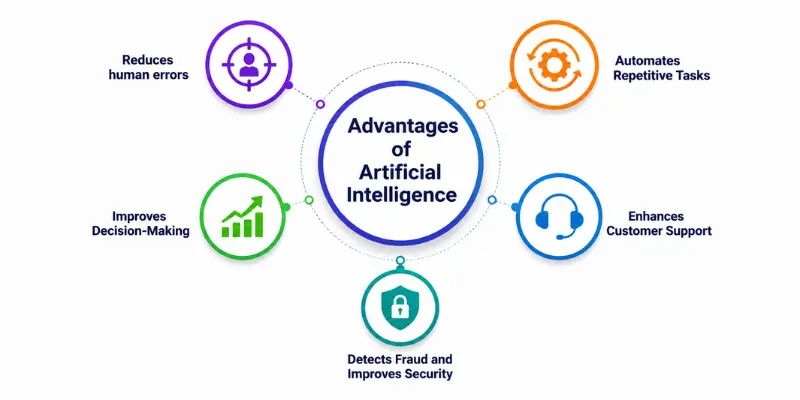
1. Reduces Human Errors
One of the biggest advantages of AI is its ability to reduce mistakes. AI systems can process information accurately when trained with quality data. For example, AI can help doctors analyze medical images and identify health issues more accurately.
2. Works 24/7 Without Breaks
Unlike humans, AI systems do not need sleep, vacations, or breaks. They can work continuously throughout the day and night. This helps businesses provide customer support and services at any time.
3. Increases Productivity and Efficiency
AI can complete tasks faster than humans in many situations. It can process large amounts of information in seconds and perform repetitive tasks quickly. As a result, organizations can improve efficiency and save valuable time.
4. Automates Repetitive Tasks
Many jobs involve routine and repetitive activities. AI can automate these tasks, allowing employees to focus on more important work. Examples include data entry, appointment scheduling, and customer inquiries.
5. Improves Decision-Making
AI analyzes large datasets and provides useful insights. Businesses use AI to identify trends, understand customer behavior, and make informed decisions. Better decisions often lead to improved results and higher productivity.
6. Enhances Customer Support
AI-powered chatbots can answer common questions and provide instant support to customers. This improves customer experience and reduces waiting times.
7. Improves Healthcare Services
Healthcare organizations use AI to assist with disease detection, medical research, and patient monitoring. AI helps medical professionals make faster and more accurate decisions.
8. Supports Personalized Learning
AI is transforming education by providing personalized learning experiences. Students can receive recommendations, learning materials, and feedback based on their individual needs.
9. Detects Fraud and Improves Security
Banks and financial institutions use AI to monitor transactions and identify suspicious activities. This helps reduce fraud and improve financial security.
10. Drives Innovation
AI encourages innovation by helping researchers and businesses develop new products and solutions. Many modern technologies, including smart assistants and advanced automation tools, are powered by AI.
11. Helps Businesses Save Time and Costs
By automating tasks and improving efficiency, AI helps organizations reduce operational costs and increase productivity. Many businesses use AI to optimize workflows and improve performance.
12. Makes Information More Accessible
AI-powered tools can summarize information, translate languages, and assist users in finding relevant content quickly. This makes information more accessible to people around the world.
Disadvantages of Artificial Intelligence
Here are the following drawbacks of AI:
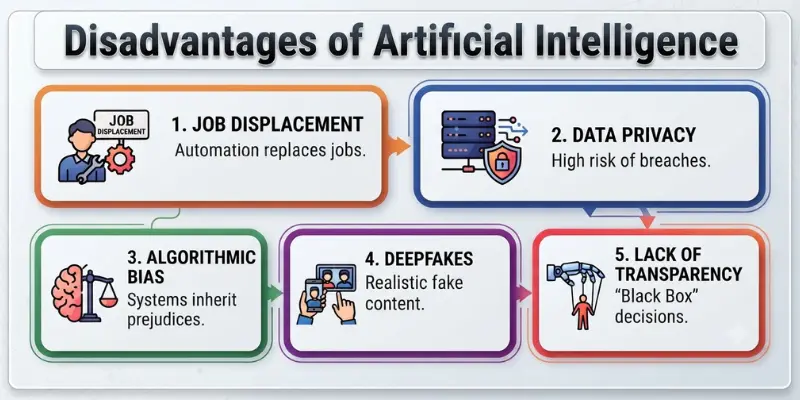
1. High Development and Maintenance Costs
Building and maintaining AI systems can be expensive. Organizations often need specialized hardware, software, and skilled professionals. Small businesses may find these costs difficult to manage.
2. Job Displacement
As AI automates certain tasks, some jobs may be replaced by machines. Although AI can create new opportunities, workers may need to learn new skills to adapt to changing job markets.
3. Lacks Human Emotions
AI can analyze data and perform tasks, but it cannot truly understand emotions, empathy, or human relationships. This limitation can affect situations that require emotional intelligence.
4. Privacy Concerns
AI systems often rely on large amounts of data. If personal information is not handled properly, privacy risks can increase. Organizations must protect user data and follow privacy regulations.
5. Cybersecurity Risks
AI systems can become targets for hackers and cybercriminals. Security vulnerabilities may lead to data breaches or misuse of information.
6. Can Produce Biased Results
AI learns from data. If the training data contains bias, the AI system may generate unfair or inaccurate outcomes. Developers must carefully monitor and improve AI models.
7. Overdependence on Technology
Many people rely heavily on technology for daily activities. Excessive dependence on AI may reduce critical thinking and problem-solving skills.
8. Ethical and Legal Challenges
AI raises important questions about responsibility, fairness, and transparency. Governments and organizations continue to develop regulations to address these concerns.
9. Deepfakes and Misinformation
AI can create realistic images, videos, and audio that may be used to spread false information. This has become a growing challenge in the digital world.
10. Lack of Transparency
Some AI systems make decisions through complex processes that are difficult to understand. This can make it challenging to explain how certain outcomes were reached.
11. Risk of Misuse
Like many technologies, AI can be used for both positive and negative purposes. If used irresponsibly, AI may cause harm or create security risks.
12. Environmental Impact
Training large AI models requires significant computing power and energy. As AI adoption grows, organizations must focus on sustainable and energy-efficient solutions.
Real-Life Examples of Artificial Intelligence
Artificial intelligence is already part of everyday life. Some common examples include:
- Virtual assistants
- AI chatbots
- Recommendation systems
- Language translation tools
- Navigation applications
- Fraud detection systems
- Smart home devices
These applications demonstrate how AI improves convenience and efficiency.
Is Artificial Intelligence Good or Bad?
Artificial intelligence is neither completely good nor completely bad. Its impact depends on how it is developed and used.
When used responsibly, AI can improve healthcare, education, business operations, and daily life. However, misuse of AI can create privacy, security, and ethical concerns.
The goal should be to maximize the benefits of AI while minimizing its risks.
Future of Artificial Intelligence
The future of AI looks promising. AI is expected to become more advanced and integrated into various industries.
In the coming years, AI may further improve healthcare, transportation, education, scientific research, and business operations.
At the same time, governments, researchers, and organizations will continue working on AI safety, transparency, and responsible development.
Conclusion
Artificial intelligence is transforming the world by improving efficiency, productivity, and innovation. It offers many advantages, such as reducing human errors, automating tasks, supporting healthcare, and enhancing decision-making.
However, AI also has disadvantages, including privacy concerns, job displacement, security risks, and ethical challenges.
Understanding both the advantages and disadvantages of artificial intelligence is important for individuals, businesses, and governments. By using AI responsibly, society can benefit from its potential while addressing its challenges effectively.
FAQs
AI helps reduce human errors, automate repetitive tasks, improve productivity, provide better customer support, and support innovation in different industries.
The main disadvantages of AI include privacy concerns, high development costs, job displacement, cybersecurity risks, and ethical challenges.
AI is used in virtual assistants, search engines, navigation apps, recommendation systems, online shopping, smart devices, and customer service chatbots.
AI can automate some tasks and replace certain jobs, but it can also create new career opportunities that require advanced skills and human creativity.
Healthcare, education, finance, transportation, manufacturing, retail, and customer service are among the industries that benefit significantly from AI.

- Be Respectful
- Stay Relevant
- Stay Positive
- True Feedback
- Encourage Discussion
- Avoid Spamming
- No Fake News
- Don't Copy-Paste
- No Personal Attacks
- Be Respectful
- Stay Relevant
- Stay Positive
- True Feedback
- Encourage Discussion
- Avoid Spamming
- No Fake News
- Don't Copy-Paste
- No Personal Attacks
