Types of artificial intelligence
Published: 19 Jul 2026
Artificial intelligence is rapidly changing the way people work, learn, and interact with technology. From smart assistants and recommendation systems to advanced AI tools, intelligent systems are becoming a part of everyday life. However, many people do not realize that artificial intelligence is not a single technology. Instead, it includes different types that vary in capabilities, functionality, and intelligence.
Understanding these AI types is important because each one serves a different purpose and powers different technologies. Some AI systems can only perform specific tasks, while others have the potential to think, learn, and make decisions in more advanced ways. As AI continues to evolve in 2026, learning about its different types can help you better understand the technology shaping the future.
In this guide, we will explore the 10 types of artificial intelligence, their features, examples, and real-world applications, in a simple, beginner-friendly way.
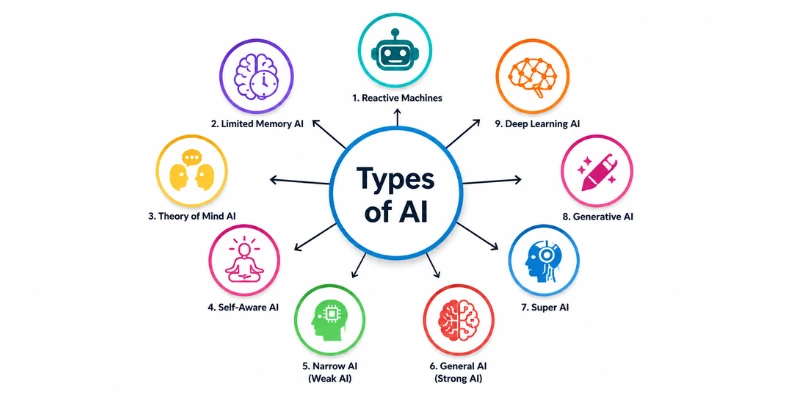
What Are the Types of Artificial Intelligence?
Here are the most common types of artificial intelligence:
- Reactive Machines
- Limited Memory AI
- Theory of Mind AI
- Self-Aware AI
- Narrow AI (Weak AI)
- General AI (Strong AI)
- Super AI
- Generative AI
- Machine Learning AI
- Deep Learning AI
Let’s explore each type in detail and understand how it works in real life.
10 types of AI
Below is a detailed guide on AI types
1. Reactive Machines
Reactive machines are the simplest form of Artificial Intelligence. These systems operate only in the present moment and respond directly to the input they receive. They do not analyze past experiences or store any memory for future use.
Because of this limitation, Reactive Machines cannot improve themselves over time. They always follow predefined rules and produce the same output for the same input every time. This makes them reliable for basic and repetitive tasks.
Key Features:
- Respond only to current input
- Do not use past data or memory
- Cannot learn or improve over time
- Work on fixed programmed rules
- Best for simple and controlled environments
Example:
- IBM Deep Blue chess system
- Basic rule-based game AI
In short, Reactive Machines are rule-based AI systems that react instantly but do not learn or evolve.
2. Limited Memory AI
Limited-memory AI is a type of artificial intelligence that uses past data for a short time to make better decisions. It learns from historical information and combines it with current input to improve its output.
This type of AI is widely used in modern applications. It continuously updates itself by analyzing new data, making it more accurate over time. However, it does not store long-term memories like humans.
Key Features:
- Uses past data for short-term decisions
- Improves results through learning from data
- Can adapt based on new information
- Commonly used in real-world AI systems
- Does not store permanent memory
Example:
- Self-driving cars (traffic and road analysis)
- Virtual assistants like Siri and Google Assistant
- Recommendation systems (YouTube, Netflix)
In simple terms, Limited Memory AI uses past experience for a short time to make smarter, more accurate decisions.
3. Theory of Mind AI
Theory of Mind AI is an advanced, still-experimental branch of artificial intelligence. It focuses on building systems that can understand human emotions, intentions, and social behavior. The main idea behind this AI is to make machines more aware of how humans think and feel during interaction.
Researchers are still working on developing this type of AI. It is not available in practical use yet, but it is considered an important step toward more human-like intelligent systems. If achieved, it will improve communication between humans and machines in a much more natural way.
Key Features:
- Focuses on emotional intelligence and social understanding
- Studies human behavior patterns during interaction
- Aims to improve human-like communication in AI systems
- Still in the research phase, not fully developed
- Considered a step toward advanced human-centered AI
Example:
- Experimental emotional recognition robots
- Research-based AI communication models
In simple words, Theory of Mind AI is a future concept that aims to help machines understand human emotions and behavior more naturally and intelligently.
4. Self-Aware AI
Self-Aware AI is the most advanced and theoretical form of artificial intelligence. It represents a system that has its own consciousness and awareness. This means the AI would not only understand the world but also understand itself.
At present, Self-Aware AI does not exist. It is only a concept studied in science fiction and advanced research discussions. If it is ever developed, it could think, make decisions, and possibly act independently like a human being.
Key Features
- Has theoretical self-consciousness
- Can understand its own existence
- Would make independent decisions
- Not developed in real-world systems yet
- Considered the highest level of AI evolution
Example
- No real-world example exists
- Only seen in movies and theoretical research
In simple terms, Self-Aware AI is a future concept in which machines may become self-aware, just as humans do, but it is not possible with current technology.
5. Narrow AI (Weak AI)
Narrow AI is the most common type of artificial intelligence used in today’s digital world. It is designed to perform a specific task very efficiently. However, it cannot go beyond its defined purpose or think outside its programming.
This type of AI powers most of the tools and apps we use daily. It works by analyzing data and following trained models to deliver accurate results for a single task at a time.
Key Features
- Designed for one specific task
- Works with trained data and models
- Cannot perform beyond its defined function
- Highly accurate within its limited scope
- Widely used in real-world applications
Example
- Chatbots like ChatGPT
- Google Search system
- Face recognition in smartphones
- Recommendation systems (YouTube, Netflix)
In simple words, Narrow AI is a task-focused system that works intelligently but only within a limited area.
6. General AI (Strong AI)
General AI is a theoretical form of artificial intelligence that aims to perform any intellectual task that a human can do. It is designed to think, understand, learn, and apply knowledge across different fields, just as human intelligence does.
Unlike Narrow AI, General AI is not limited to one task. It can adapt to new situations, solve unfamiliar problems, and transfer knowledge from one area to another. However, this type of AI has not been fully developed yet and remains a long-term research goal.
Key Features
- Can perform multiple tasks like a human
- Learns and adapts in different situations
- Transfers knowledge across domains
- Requires human-level reasoning ability
- Still under research and not fully achieved
Example
- No real-world system exists yet
- Advanced research models in AI labs
- Theoretical human-like intelligent machines
In simple terms, General AI is a future concept in which machines will be as intelligent and flexible as humans across all types of tasks.
7. Super AI
Super AI is a hypothetical and the most advanced level of artificial intelligence. It is expected to go beyond human intelligence in every possible way. This type of AI would not only match human thinking but also outperform humans in creativity, decision-making, and problem-solving.
At present, Super AI does not exist. It is only a theoretical concept discussed in science fiction and future technology studies. Researchers are still exploring whether such intelligence is possible in reality.
Key Features
- Would be smarter than human intelligence
- Can solve extremely complex problems
- May show advanced creativity and reasoning
- Fully independent decision-making ability
- Currently only a theoretical concept
Example
- No real-world example exists
- Common in science fiction movies and books
- Future AI research discussions
In simple terms, Super AI is a concept in which machines could become more intelligent than humans across almost every field.
8. Generative AI
Generative AI is a modern type of artificial intelligence that creates new content based on learned data. It can generate text, images, audio, video, and even code. This AI learns patterns from large datasets and then produces original outputs.
In 2026, Generative AI will be widely used in content creation, design, marketing, and education. It helps users save time and create high-quality content in seconds. Tools like ChatGPT and image generators are popular examples of this technology.
Key Features
- Creates new content like text, images, and videos
- Learns patterns from large datasets
- Improves creativity and productivity
- Used in many digital industries
- Works through advanced AI models
Example
- ChatGPT (text generation)
- DALL·E / Midjourney (image generation)
- AI video and music tools
In simple words, Generative AI is a creative technology that produces new digital content using learned information.
9. Machine Learning AI
Machine Learning AI is a branch of artificial intelligence that allows systems to learn from data and improve their performance over time without being explicitly programmed. It focuses on identifying patterns and making predictions based on past information.
In modern technology, Machine Learning is widely used in apps, websites, and digital services. It helps systems become smarter as they process more data, making results more accurate and useful.
Key Features:
- Learns from data automatically
- Improves performance over time
- Identifies patterns and trends
- Used in prediction and analysis
- Does not require fixed programming for every task
Example
- Email spam filters
- Product recommendation systems
- Fraud detection in banking
- Weather prediction systems
In simple words, Machine Learning AI helps computers learn from experience and make better decisions without direct human instructions.
10. Deep Learning AI
Deep Learning AI is an advanced form of Machine Learning that uses complex neural networks to process large amounts of data. It is designed to operate in a manner similar to the human brain, analyzing information across multiple layers.
This type of AI is very powerful in handling unstructured data such as images, audio, and text. It requires large datasets and substantial computing power to produce accurate, fast results. Deep Learning is the main technology behind many modern AI systems.
Key Features
- Uses multi-layer neural networks
- Works well with large and complex data
- Processes images, speech, and text efficiently
- Requires high computing power
- Improves accuracy with more data
Example
- Facial recognition systems
- Voice assistants like Alexa and Siri
- Self-driving car technology
- AI translation tools
In simple terms, Deep Learning AI helps machines understand and process complex information in a more advanced, human-like way.
Conclusion
So, guys, you now have a clear understanding of the 10 types of artificial intelligence and their roles in the modern world. From basic AI systems like Reactive Machines to advanced concepts such as Super AI, each type represents a different stage in the evolution of artificial intelligence.
Today, AI is transforming industries, improving productivity, and changing the way people interact with technology. As research continues to advance, we can expect AI to become even more powerful and useful in the coming years.
My personal recommendation: Don’t try to learn every AI concept at once. Start with the AI types already in use today, such as Narrow AI, machine learning, Deep Learning, and Generative AI. Once you understand these foundations, exploring more advanced AI concepts will become much easier and more enjoyable.
FAQs about types of AI
Narrow AI is the most commonly used type of artificial intelligence. It powers search engines, chatbots, recommendation systems, and voice assistants. Most AI tools available today are examples of Narrow AI.
Narrow AI is designed to perform specific tasks within a limited area. General AI, on the other hand, would be able to learn, think, and solve problems across multiple domains like a human. General AI has not been achieved yet.
No, Self-Aware AI does not exist today. It is a theoretical concept where machines would have consciousness and awareness of their own existence. Researchers are still far from developing this type of AI.
ChatGPT is an example of Generative AI and Narrow AI. It can generate human-like text, answer questions, and assist with various tasks. However, it is still limited to specific functions and does not possess human-level intelligence.
Super AI is considered the most advanced type of artificial intelligence. It is a theoretical concept that would surpass human intelligence in reasoning, creativity, and decision-making. However, it does not exist in the real world yet.

- Be Respectful
- Stay Relevant
- Stay Positive
- True Feedback
- Encourage Discussion
- Avoid Spamming
- No Fake News
- Don't Copy-Paste
- No Personal Attacks
- Be Respectful
- Stay Relevant
- Stay Positive
- True Feedback
- Encourage Discussion
- Avoid Spamming
- No Fake News
- Don't Copy-Paste
- No Personal Attacks
