What Is Reactive Machines? Understanding the Simplest Type of AI in 2026
Published: 23 Jul 2026
Artificial Intelligence (AI) has evolved rapidly over the years. Today, AI can generate content, analyze data, automate tasks, and even assist with complex decision-making.
However, modern AI did not appear overnight. Before advanced AI systems existed, researchers developed simpler AI models that could perform specific tasks and respond to particular situations.
One of the earliest and most important types of AI is reactive machines. While these systems may seem basic compared to today’s intelligent technologies, they helped lay the foundation for many AI advancements we see today.
In this guide, you will learn what reactive machines are, how they work, their key characteristics, real-world examples, advantages, limitations, and why they still matter in 2026.
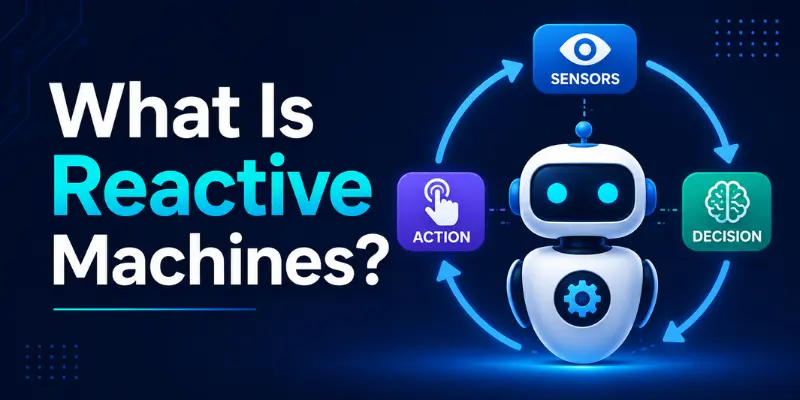
What are reactive machines?
Reactive machines are the simplest type of artificial intelligence. They respond to current inputs and situations without storing memories or learning from past experiences.
These AI systems analyze the information available at the present moment and make decisions based only on that data. They cannot remember past actions, adapt over time, or learn from experience.
How the Idea of Reactive Machines Started
When researchers first began developing artificial intelligence, they focused on creating systems that could solve specific problems.
Early computers had limited memory and processing power. Because of these limitations, scientists designed AI systems that reacted only to the information available at the moment. These systems followed predefined rules and decision-making processes.
Instead of learning from experience, they evaluated current conditions and selected the most appropriate response. This approach became the foundation of reactive machine AI.
How Reactive Machines Work
Reactive machines operate only on present data. When they receive an input, they process the information and generate an output based on predefined rules or programmed logic. The system does not store information for future use. It treats every new situation as an independent event.
Simple Process of a Reactive Machine
- Receive current input
- Analyze the available data
- Apply programmed rules
- Generate a response
- End the process
The system repeats this process every time it receives new information.
Because it cannot remember previous interactions, it always starts from the current situation.
Key Characteristics of Reactive Machines
Reactive machines share several unique characteristics.
- No Memory: Cannot store past information or experiences.
- No Learning Ability: Does not learn or improve over time.
- Fast Decision-Making: Processes current data quickly and efficiently.
- Task-Specific Design: Performs specific tasks with high accuracy.
- Predictable Outputs: Produces consistent results for the same input.
- Present-Focused Operation: Uses only current information to make decisions.
- Rule-Based Functionality: Follows predefined rules and instructions.
- Low Complexity: Has a simple structure compared to advanced AI systems.
- Limited Adaptability: Cannot adjust to new situations on its own.
- Reliable Performance: Works consistently in controlled environments.
Real-World Examples of Reactive Machines
Several well-known AI systems demonstrate how reactive machines work.
1. IBM Deep Blue
IBM Deep Blue is one of the most famous examples of reactive machine AI. It defeated world chess champion Garry Kasparov in 1997. The system analyzed the current chessboard and selected the best move without remembering previous games.
2. Rule-Based Industrial Robots
Many factory robots operate as reactive machines. They respond to specific inputs and perform repetitive tasks based on programmed instructions. These robots do not learn from experience.
3. Basic Traffic Signal Systems
Some traditional traffic management systems react to current traffic conditions. They use sensors to detect vehicles and adjust signal timings based on real-time data.
4. Automated Manufacturing Equipment
Many manufacturing machines react to sensor inputs during production. They perform specific actions when certain conditions are met but cannot adapt beyond their programming.
5. Basic Game-Playing AI
Simple game AI systems often react only to the current game state. They follow predefined rules to make decisions without learning from previous matches.
6. Rule-Based Customer Support Systems
Some basic chatbots use predefined responses to answer user questions. They react to specific keywords and commands without understanding context or learning from interactions.
7. Sensor-Based Security Systems
Many security systems detect motion, heat, or unusual activity and immediately trigger alarms. These systems respond to current conditions without storing long-term memories.
8. Automatic Door Systems
Automatic doors use sensors to detect nearby people. When someone approaches, the system opens the door. It does not remember previous users or learn from past events.
Advantages of Reactive Machines
Reactive machines offer several benefits.
Key Advantages
- Simple design
- Fast processing
- Predictable behavior
- Lower computational requirements
- Reliable task execution
- Easier maintenance
- Reduced complexity
- Quick decision-making
- Strong performance in specific tasks
- Lower development costs
Because of these advantages, reactive systems remain useful in many controlled environments.
Limitations of Reactive Machines
Despite their strengths, reactive machines have significant limitations.
Key Limitations
- No memory
- No learning capability
- Limited adaptability
- Cannot improve performance
- Cannot understand the context
- No long-term planning
- Restricted decision-making
- Limited problem-solving ability
- Dependence on programmed rules
- Poor performance in dynamic environments
These limitations prevent reactive machines from handling many modern AI tasks.
Reactive Machines vs Limited Memory AI
Reactive machines and limited-memory AI are often confused.
However, they work differently.
| Feature | Reactive Machines | Limited Memory AI |
| Memory | No | Yes |
| Learning Ability | No | Limited |
| Uses Past Data | No | Yes |
| Adaptability | Low | Moderate |
| Decision-Making | Present only | Present and past data |
Limited-memory AI can use historical information to improve decision-making. Reactive machines cannot.
Why Reactive Machines Still Matter in 2026
Modern AI systems are far more advanced than reactive machines. However, reactive machines still matter for several reasons.
1. Foundation of AI Development
Reactive machines helped researchers understand how machines could make decisions. They laid the groundwork for future AI technologies.
2. Useful for Specific Tasks
Many applications do not require memory or learning. Reactive systems can still perform these tasks efficiently.
3. Easier to Control
Organizations often prefer predictable AI systems in environments where safety and reliability are critical.
4. Lower Resource Requirements
Reactive machines require fewer computing resources than advanced AI models. This makes them suitable for simple applications and embedded systems.
Types of AI and Where Reactive Machines Fit
Researchers commonly divide AI into four major categories.
| AI Type | Description |
| Reactive Machines | Respond only to current inputs |
| Limited Memory | Uses past data for decisions |
| Theory of Mind | Understands emotions and intentions (under development) |
| Self-Aware AI | Hypothetical future AI |
Reactive machines represent the first and simplest level of artificial intelligence.
Common Use Cases of Reactive Machines
Even in 2026, reactive machine concepts appear in many systems.
Common applications include:
- Industrial automation
- Manufacturing equipment
- Basic robotics
- Traffic control systems
- Rule-based software
- Game-playing systems
- Simple recommendation tools
- Sensor-based automation
- Process control systems
- Embedded devices
These systems perform specific tasks without requiring advanced learning capabilities.
The Future of Reactive Machine AI
Reactive machines will not replace modern AI systems.
However, they will continue serving important roles in environments that require speed, simplicity, and reliability. Many organizations still use reactive systems because they are easier to deploy, monitor, and maintain.
As AI technology evolves, reactive machines will remain a foundational concept for understanding how intelligent systems make decisions.
They may be simple, but they continue to play a valuable role in the broader AI landscape
Conclusion
So guys, now you have a clear understanding of reactive machines and their role in artificial intelligence. Although reactive machines are the simplest type of AI, they played a major role in the development of modern intelligent systems. Their ability to analyze current situations and respond quickly helped lay the foundation for more advanced AI technologies.
In 2026, reactive machines are still useful in many industries because they are reliable, fast, and easy to manage. As AI continues to evolve, understanding reactive machines helps you appreciate how far artificial intelligence has come and where it may go in the future.
Frequently Asked Questions
A reactive machine is the most basic type of artificial intelligence. It responds to current inputs without remembering past events or learning from experience.
They are called reactive because they react only to present information. They do not store memories or use past data when making decisions.
IBM Deep Blue is one of the most famous examples. It defeated chess champion Garry Kasparov by analyzing the current chessboard without using memory from previous games.

- Be Respectful
- Stay Relevant
- Stay Positive
- True Feedback
- Encourage Discussion
- Avoid Spamming
- No Fake News
- Don't Copy-Paste
- No Personal Attacks
- Be Respectful
- Stay Relevant
- Stay Positive
- True Feedback
- Encourage Discussion
- Avoid Spamming
- No Fake News
- Don't Copy-Paste
- No Personal Attacks
