Artificial Intelligence Overview
Published: 19 Jul 2026
Many people use digital devices every day, but they do not understand what actually makes these systems so fast, smart, and responsive. They use search engines, social media apps, and mobile tools that can predict their needs, yet the technology behind these features often feels unclear and complex.
This gap between daily usage and real understanding creates strong curiosity about how modern systems actually work and what powers them in the background. As digital technology continues to grow in 2026, this curiosity becomes even more important, as artificial intelligence is now deeply integrated into almost every online experience, from simple mobile apps to advanced automation systems across industries.
So, in this guide, you will learn what artificial intelligence is, how it works, its main types, real-life examples, advantages and disadvantages, and how AI is shaping the future in simple and beginner-friendly words.
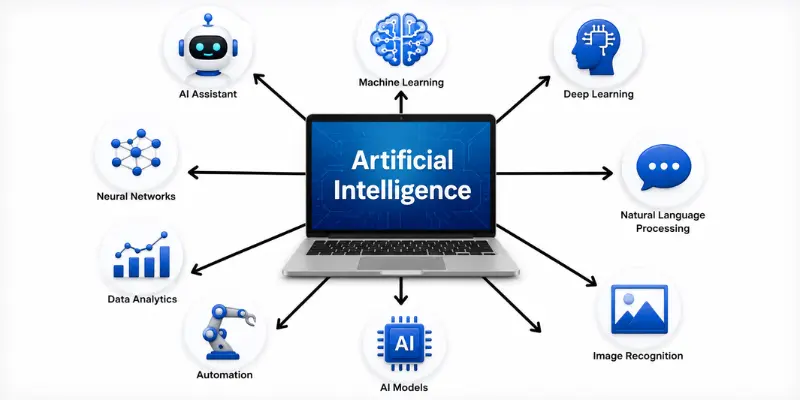
What is artificial intelligence?
Artificial Intelligence (AI) is a technology that enables machines and computer systems to perform tasks that normally require human intelligence. It allows computers to learn from data, identify patterns, understand language, and make decisions with minimal human involvement. Instead of following only fixed instructions, AI systems improve their performance over time by analyzing new information.
In simple words, artificial intelligence makes machines “smart” so they can think and respond in a way that feels similar to humans. In 2026, AI is widely used in everyday tools like search engines, mobile apps, voice assistants, and chatbots, helping people complete tasks faster and more efficiently.
How Does Artificial Intelligence Work?
Artificial Intelligence works through a step-by-step process where machines use data and smart algorithms to perform intelligent tasks. It does not work like traditional programming, where fixed instructions are followed. Instead, AI systems learn from information and improve their performance over time.
1. Data Input
AI systems first collect and receive large amounts of data. This data can come from text, images, videos, sensors, or user interactions. The quality of data directly affects how well AI performs.
2. Algorithms
AI uses algorithms, which are sets of rules and mathematical instructions. These algorithms help the system understand patterns, relationships, and hidden information inside the data.
3. Machine Learning Process
In this stage, AI learns from the data using machine learning models. The system trains itself by analyzing past examples and improves its accuracy with experience, without being explicitly programmed for every task.
4. Output Generation
After processing and learning from data, AI produces results. This output can be predictions, recommendations, answers, or automated actions, depending on the task.
In simple terms, AI takes data, learns from it, processes it with algorithms, and then delivers smart results that help humans complete tasks faster and more efficiently.
History of Artificial Intelligence
The history of artificial intelligence shows how this technology developed step by step over many decades. It started as a simple idea and slowly turned into one of the most powerful technologies in the modern world.
Early Development (1940s–1950s)
The idea of artificial intelligence began in the 1940s and 1950s. During this time, scientists started thinking about whether machines could copy human thinking. In 1950, Alan Turing introduced the famous “Turing Test,” which helped measure machine intelligence. In 1956, the term “Artificial Intelligence” was officially introduced at a conference at Dartmouth College.
AI Evolution Stages (1960s–2010s)
From the 1960s to the 1970s, researchers worked on rule-based systems. These systems followed fixed instructions to solve problems. In the 1980s, machine learning started to develop, where computers learned from data instead of only rules. From the 1990s to the 2010s, AI improved quickly due to better computers, big data, and advanced algorithms like neural networks and deep learning. This period made AI more practical for real-world use.
Modern AI (2010s–2026)
In the modern era, AI has become highly advanced and widely used. From 2010 onwards, deep learning and big data made AI more powerful. In the 2020s, tools like ChatGPT, Google Gemini, and other generative AI systems changed how people interact with technology. In 2026, AI is used in almost every field, including education, healthcare, business, and communication, making digital life faster and more intelligent.
Types of Artificial Intelligence
Artificial intelligence is divided into different types based on its capabilities and level of intelligence. Each type shows how advanced a system is. It also explains how machines perform tasks compared to human thinking.
Here are some types of artificial intelligence.
1. Narrow AI (Weak AI)
Narrow AI is designed to perform a specific task. It cannot work beyond its trained purpose. Most AI systems we use today are narrow AI. For example, voice assistants, recommendation systems, and chatbots all use narrow AI. It is smart, but it has limited ability.
2. General AI (Strong AI)
General AI is a type of artificial intelligence that can understand, learn, and perform any intellectual task like a human. It can think, reason, and solve problems in different fields. However, General AI is still under research. It has not been fully developed yet.
3. Super AI
Super AI is a future concept of artificial intelligence. It is expected to become smarter than human intelligence. It will be able to think, make decisions, and solve complex problems better than humans. At present, Super AI does not exist. It is only a theoretical idea.
In simple words, AI ranges from simple task-based systems to advanced systems that may one day think beyond human intelligence.
Core Technologies Behind AI
Artificial Intelligence is built on several core technologies. These technologies help machines learn, understand, and perform intelligent tasks. Each technology plays an important role in making AI systems more advanced and accurate.
1. Machine Learning
Machine Learning is a key part of AI. It allows systems to learn from data without being explicitly programmed. The more data the system gets, the better it performs. It helps in prediction, classification, and decision-making tasks.
2. Deep Learning
Deep Learning is an advanced form of Machine Learning. It uses multiple layers of algorithms to process complex data. It is especially useful for image recognition, speech processing, and language understanding.
3. Neural Networks
Neural Networks are designed to work like the human brain. They consist of connected nodes that process information in layers. These networks help AI systems recognize patterns and make intelligent decisions.
4. Natural Language Processing (NLP)
Natural Language Processing helps machines understand and respond to human language. It allows AI systems to read text, understand meaning, and generate responses. It is used in chatbots, translation tools, and voice assistants.
Real-Life Examples of AI
Artificial Intelligence is now part of our daily lives. We use AI systems every day, often without realizing it. These systems make our work faster, easier, and more personalized.
- Smartphones: Modern smartphones use AI for face recognition, camera improvement, battery optimization, and smart typing suggestions.
- Social Media (Instagram, TikTok): These platforms use AI to analyze user behavior. They show personalized posts, videos, and ads based on interests.
- Voice Assistants (Siri, Alexa): Use AI to understand spoken language. They answer questions, set reminders, play music, and control smart devices.
- Google Search: Google uses AI to understand user intent. It provides fast, accurate, and relevant search results. It also improves auto-suggestions.
- Chatbots: Chatbots use AI to talk with users in real time. They answer questions, solve problems, and provide customer support on websites and apps.
Applications of Artificial Intelligence
Artificial Intelligence is widely used in many industries today. It helps automate tasks, improve accuracy, and save time. AI is changing how businesses and services work in the modern world.
- Education: AI is used in smart learning platforms, personalized study plans, and automated grading systems.
- Healthcare: AI supports disease diagnosis, medical imaging, patient monitoring, and treatment recommendations.
- Business: AI improves decision-making, automates tasks, and enhances productivity in organizations.
- Marketing: AI is used for audience targeting, ad optimization, and personalized content recommendations.
- Finance: AI detects fraud, analyzes financial data, and improves banking and transaction systems.
- Transportation: AI powers self-driving cars, traffic management systems, and route-optimization systems.
Overall, artificial intelligence is quietly becoming a part of our daily life, making work easier, faster, and more efficient in almost every field.
Advantages and Disadvantages of Artificial Intelligence
Artificial intelligence is widely used in today’s digital world to make tasks faster, smarter, and more efficient. It helps industries automate processes and improve decision-making. However, it also comes with certain risks and limitations that cannot be ignored. Here are some pros and cons of AI.
Advantages of Artificial Intelligence
| Benefits |
|---|
|
Disadvantages of Artificial Intelligence
| Drawbacks |
|---|
|
Conclusion
So, guys, you now understand what artificial intelligence is in detail. This complete guide has given you a clear and simple understanding of AI in an easy, beginner-friendly way.
So, artificial intelligence is no longer just a future idea. It is now a real technology that is changing how we live and work every day. From education and healthcare to business and communication, AI is making everything faster, smarter, and more efficient. It is important to understand these basics so you can stay up to date with the modern digital world.
My personal recommendation: If you are a beginner, start practicing with simple AI tools and real examples. Try using platforms like ChatGPT, AI image generators, and other automation tools in your daily tasks. This practical experience will help you understand AI better and prepare you for future opportunities in this fast-growing field.
FAQs on Artificial Intelligence
Popular AI tools include ChatGPT, Google Gemini, Siri, Alexa, and image generation tools. These tools help users write, search, create, and automate tasks. AI tools are becoming more advanced every year.
AI is important because it saves time, increases efficiency, and improves decision-making. It helps industries work faster and smarter. In 2026, AI is a key part of digital transformation.
Yes, beginners can easily start learning AI with basic concepts and simple tools. No advanced coding is needed at the start. Practice and exploration make learning AI easier and practical.

- Be Respectful
- Stay Relevant
- Stay Positive
- True Feedback
- Encourage Discussion
- Avoid Spamming
- No Fake News
- Don't Copy-Paste
- No Personal Attacks
- Be Respectful
- Stay Relevant
- Stay Positive
- True Feedback
- Encourage Discussion
- Avoid Spamming
- No Fake News
- Don't Copy-Paste
- No Personal Attacks
