History of Artificial Intelligence
Published: 19 Jul 2026
Artificial Intelligence (AI) stands among the most exciting technologies of the modern era. Today, AI helps people search for information, create content, translate languages, recommend products, and assist doctors in diagnosing diseases. People now use AI in their daily lives, but its journey started many decades ago.
The history of artificial intelligence spans several decades and includes ambitious ideas, groundbreaking discoveries, major successes, and significant setbacks. Researchers began this journey with a simple question: “Can machines think?” Over time, they transformed that question into a global field that now shapes industries and changes how people work and live.
When we study the history of AI, we understand how researchers developed this technology over time and why modern AI systems perform far better than the early experiments that inspired them.
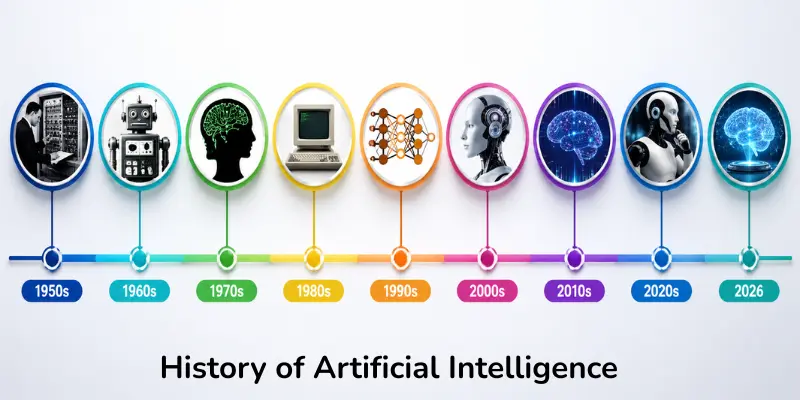
Quick Answer: What Is the History of Artificial Intelligence?
Researchers began exploring artificial intelligence by studying ways to make machines imitate human thinking. The field officially started in 1956 during the Dartmouth Conference, where John McCarthy introduced the term “artificial intelligence.” Since then, researchers have advanced AI through several stages, including early experimentation, AI winters, expert systems, machine learning, deep learning, and generative AI.
The Origins of Artificial Intelligence
Long before inventors created computers, people imagined intelligent machines. Ancient myths and stories often featured mechanical beings that performed human-like actions. Although these stories were fictional, they revealed humanity’s fascination with creating intelligent machines.
During the early 20th century, mathematicians and scientists started exploring whether they could represent human reasoning through logic and mathematics. Their work laid the intellectual foundation for artificial intelligence.
As computing technology advanced, researchers actively searched for ways to build machines that could solve problems, make decisions, and process information. Their efforts eventually gave birth to the field of artificial intelligence.
Alan Turing’s Vision
One of the most influential figures in AI history was Alan Turing.
In 1950, Turing published a groundbreaking paper that explored machine intelligence. Instead of debating whether machines could think exactly like humans, he proposed a practical method for evaluating machine behavior.
Researchers later named this concept the Turing Test. The test examined whether a machine could carry on a conversation so effectively that a person could not distinguish it from a human.
Turing’s ideas inspired generations of researchers and helped shape the future of artificial intelligence.
His major contributions include:
- Introducing the concept of machine intelligence
- Influencing the development of modern computing
- Establishing foundations for AI evaluation
- Inspiring future AI research
Despite the technological limitations of his time, Turing showed researchers that intelligent machines could become a reality.
1956 – The Birth of Artificial Intelligence
Although earlier researchers established the foundations of AI, the year 1956 marked the official beginning of artificial intelligence as a field of study.
During the summer of 1956, researchers gathered at Dartmouth College in the United States to discuss whether machines could simulate human intelligence. Their meeting became one of the most important events in technology history. The participants believed they could understand human intelligence scientifically and reproduce some of its abilities in machines.
Their discussions launched a new field of research that later transformed the world.
The Dartmouth Conference
The Dartmouth Conference brought together some of the brightest minds in mathematics and computing.
The researchers focused on topics such as:
- Problem-solving
- Learning systems
- Language understanding
- Machine reasoning
- Human intelligence simulation
Although many participants underestimated the difficulty of creating intelligent machines, they successfully established AI as a legitimate academic discipline.
Today, historians widely recognize the Dartmouth Conference as the starting point of modern artificial intelligence research.
John McCarthy and the New Field of AI
John McCarthy played a central role in the Dartmouth Conference.
He introduced the term “Artificial Intelligence” and promoted the idea that machines could eventually perform tasks that required human intelligence.
McCarthy’s vision influenced AI research for decades and helped researchers build a strong foundation for future innovation.
His achievements include:
- Coining the term Artificial Intelligence
- Organizing the Dartmouth Conference
- Promoting AI research in universities
- Contributing to AI programming techniques
McCarthy and his colleagues laid the groundwork for many of the breakthroughs that followed.
1960s and 1970s – Early Optimism and Research
After the Dartmouth Conference, interest in artificial intelligence grew rapidly. Researchers believed they could develop intelligent machines within a relatively short period.
Governments, universities, and research organizations invested heavily in AI projects. Scientists created programs that solved mathematical problems, played games, and performed basic reasoning tasks.
This period generated tremendous excitement. Many experts predicted that machines would soon perform tasks that required human intelligence.
Researchers focused their efforts on:
- Problem-solving algorithms
- Symbolic reasoning
- Language processing
- Computer vision
- Knowledge representation
While researchers achieved important progress, technological limitations prevented AI systems from reaching their ambitious goals.
Why Expectations Were So High
Early AI successes convinced many researchers that they could achieve human-level intelligence within a few decades. As computing technology improved, optimism continued to grow.
Several factors fueled these expectations:
- Rapid computing advancements
- Successful AI demonstrations
- Increased government funding
- Growing public interest in technology
Many people genuinely believed that intelligent machines would soon become part of everyday life.
The Challenges Researchers Faced
Despite their optimism, researchers encountered major obstacles. Computers in the 1960s and 1970s lacked the power, memory, and storage capacity required for advanced AI applications.
AI systems also struggled with tasks that humans performed naturally, such as understanding language and recognizing objects in different environments.
Researchers faced several challenges:
- Limited computing power
- Insufficient data
- High hardware costs
- Weak processing capabilities
- Difficulty handling real-world complexity
As these challenges became more obvious, AI progress slowed considerably.
The First AI Winter
By the mid-1970s, researchers realized they had underestimated the complexity of human intelligence. Many projects failed to deliver the results they had promised, and funding organizations started questioning the value of AI research.
As confidence declined, governments and investors reduced financial support for AI projects. Many organizations canceled research programs, and investment levels dropped significantly.
The industry entered a difficult period that researchers later called the First AI Winter.
Several factors contributed to this slowdown:
- Unrealistic expectations
- Slow technological progress
- Limited computer capabilities
- Disappointing research outcomes
- Reduced funding opportunities
Although the AI Winter slowed development, it did not stop innovation completely.
Instead, it encouraged researchers to rethink their strategies, improve their methods, and focus on practical solutions. These lessons later helped drive some of the most important breakthroughs in AI history.
1980s – The Rise of Expert Systems
The First AI Winter slowed progress, but researchers continued their work. During the late 1970s and early 1980s, a new approach revived interest in artificial intelligence.
Researchers developed expert systems to imitate the decision-making process of human experts. Instead of solving every type of problem, these systems focused on specific areas. They used predefined rules and expert knowledge to reach conclusions.
Businesses quickly recognized their value. Companies used expert systems to improve efficiency, reduce errors, and support decision-making. As confidence returned, investment in AI research increased again.
Organizations adopted expert systems in several industries, including:
- Healthcare
- Finance
- Manufacturing
- Engineering
- Business management
For the first time, businesses experienced practical benefits from artificial intelligence. AI was no longer just a research project. It started solving real-world problems.
How Expert Systems Changed Industries
Expert systems analyzed information and generated recommendations based on stored knowledge.
In healthcare, doctors used them to identify possible diseases from patient symptoms. In finance, analysts used them to evaluate risks and support investment decisions.
These systems offered several advantages:
- Faster decision-making
- Consistent recommendations
- Fewer human errors
- Better use of expert knowledge
- Improved productivity
Their success encouraged more companies to invest in AI technologies.
Growing Commercial Interest in AI
As expert systems gained popularity, technology companies increased their investment in AI. Universities expanded research programs. Businesses explored new AI applications. Public interest also grew rapidly. Many experts believed that artificial intelligence was finally moving toward mainstream adoption.
However, expert systems still faced important limitations.
They depended on manually written rules. They struggled when conditions changed. Updating large knowledge bases required time, money, and technical expertise.
Over time, these weaknesses created new challenges for the AI industry.
The Second AI Winter
By the late 1980s, organizations started noticing the limitations of expert systems. These systems performed well in controlled environments. However, they often failed when unexpected situations occurred. Companies also spent significant resources maintaining and updating them. As frustration increased, investment in AI declined once again.
Researchers later called this period the Second AI Winter.
Several factors contributed to the slowdown:
- High development costs
- Limited flexibility
- Expensive maintenance
- Unrealistic business expectations
- Declining investor confidence
Many organizations canceled AI projects. Funding became harder to secure. Interest in artificial intelligence dropped significantly.
Despite these setbacks, researchers did not abandon AI. Instead, they searched for better methods that could overcome the limitations of rule-based systems.
1990s – Machine Learning Changes Everything
The 1990s marked a major turning point in AI history. Researchers shifted their focus from rule-based systems to data-driven learning. Instead of programming every instruction manually, they taught computers to learn from data.
This new approach became known as machine learning. Developers provided examples and training data. The system then identified patterns and improved its performance over time.
This shift transformed artificial intelligence and opened the door to many modern applications.
From Rules to Learning
Traditional AI systems relied heavily on human-created rules. Machine learning introduced a more flexible approach.
Instead of following fixed instructions, computers learned from experience and data. The more data they processed, the better they performed.
This approach offered several advantages:
- Greater flexibility
- Higher accuracy
- Better scalability
- Improved handling of large datasets
- Continuous learning and improvement
Researchers quickly realized that machine learning could solve problems that traditional AI systems could not handle effectively.
AI Defeats a Chess Champion
One of the biggest AI milestones occurred in 1997.
IBM developed an AI-powered chess computer called Deep Blue. The system defeated world chess champion Garry Kasparov in a historic match. The event attracted worldwide attention.
For decades, people viewed chess as a game that required advanced human intelligence and strategic thinking. Deep Blue’s victory challenged that belief. The achievement demonstrated that computers could outperform humans in specific tasks.
It also renewed public interest in artificial intelligence and highlighted the growing power of modern computing.
2000s – AI Enters Everyday Life
The 2000s transformed artificial intelligence from a research topic into an everyday technology.
For many years, researchers mainly used AI in laboratories and specialized business systems. During this decade, ordinary people began using AI-powered technologies in their daily lives.
Several technological advancements accelerated this change:
- Faster computers
- Larger storage systems
- Better internet access
- Massive amounts of digital data
- More advanced algorithms
Together, these developments created ideal conditions for AI growth.
As a result, millions of people started using AI without even realizing it.
The Internet Accelerates AI Growth
The internet played a major role in AI development.
Every online search, purchase, email, and website visit generated valuable data.
Researchers used this information to train machine learning models. Larger datasets helped AI systems learn more effectively and produce better results.
At the same time, faster computers processed data more efficiently.
The combination of big data and increased computing power significantly improved AI performance.
AI Applications Become More Common
By the end of the decade, AI had become part of many everyday technologies.
People interacted with AI through:
- Search engines
- Email spam filters
- Product recommendations
- Navigation systems
- Online advertising
These applications may seem ordinary today, but they represented major progress at the time. Businesses also benefited from AI. Companies used it to analyze customer behavior, improve services, and automate repetitive tasks. These successes proved that artificial intelligence could create real value for both businesses and consumers.
A Decade That Prepared AI for the Future
The period between the 1980s and the 2000s shaped the future of artificial intelligence.
Expert systems showed that AI could solve practical business problems. The Second AI Winter exposed the weaknesses of rule-based approaches. Machine learning introduced a smarter way for computers to learn from data.
At the same time, the internet generated massive amounts of information. Faster computers gave researchers the power they needed to process it. By the end of the 2000s, AI had a strong foundation for future growth.
Researchers now had access to larger datasets, better hardware, and more advanced algorithms. These developments set the stage for the deep learning revolution that would transform artificial intelligence in the following decade.
2010s – The Deep Learning Revolution
Artificial intelligence entered a new era during the 2010s. Researchers gained access to faster computers, powerful GPUs, and massive datasets collected from the internet. These resources helped AI systems learn faster and perform more complex tasks.
As technology improved, AI became more accurate, efficient, and reliable. Researchers achieved breakthroughs that had seemed impossible only a few years earlier.
Many experts now refer to this period as the Deep Learning Revolution because deep neural networks transformed the capabilities of artificial intelligence.
Breakthroughs That Changed Artificial Intelligence
Deep learning enabled researchers to solve problems that had challenged AI systems for decades.
During this period, AI achieved major improvements in:
- Image recognition
- Speech recognition
- Language translation
- Recommendation systems
- Computer vision
These advancements pushed AI closer to human-level performance in specific tasks.
For example, voice assistants understood spoken commands more accurately. Streaming platforms recommended content more effectively. Image recognition systems identified objects with remarkable precision.
As these technologies improved, businesses and consumers began trusting AI more than ever before.
AI Moves Into Everyday Life
During the 2010s, AI became part of everyday life. Millions of people interacted with AI through:
- Virtual assistants
- Streaming recommendations
- Online shopping suggestions
- Smart home devices
- Navigation apps
Businesses also embraced AI. Companies used it to improve customer service, analyze large datasets, and automate repetitive work.
By the end of the decade, AI had moved beyond research labs. It had become a practical technology that people used every day.
2020s – The Rise of Generative AI
The 2020s opened a new chapter in the history of artificial intelligence. Earlier AI systems mainly analyzed information and identified patterns. Modern AI systems took a major step forward. They started creating original content.
This shift changed how people used technology. Instead of simply receiving information, users could now generate text, images, code, audio, and videos with simple prompts.
As a result, generative AI quickly became one of the most influential technological developments of the decade.
Why Generative AI Became a Global Trend
Several factors fueled the growth of generative AI.
Researchers developed more advanced machine learning models. Companies invested in powerful computing infrastructure. The internet provided enormous datasets for training AI systems.
These improvements allowed AI tools to create highly realistic and useful content.
People started using generative AI for:
- Writing articles and reports
- Creating marketing materials
- Designing images
- Generating code
- Conducting research
- Brainstorming ideas
Students, marketers, developers, business owners, and content creators quickly adopted these tools because they saved time and increased productivity.
How Generative AI Is Transforming Industries
Generative AI is changing the way organizations work across multiple industries.
Education
Teachers create learning materials more efficiently. Students use AI tools to summarize information, understand difficult topics, and improve their writing skills.
Healthcare
Healthcare professionals analyze medical data, support research projects, and improve patient care with AI-powered tools.
Marketing
Marketing teams create advertisements, blog posts, product descriptions, and social media content much faster than before.
Software Development
Developers use AI assistants to write code, debug applications, and speed up development workflows. As adoption continues to grow, generative AI will likely transform even more industries in the coming years.
2025–2026: The Age of AI Agents and Intelligent Automation
By 2025 and 2026, artificial intelligence entered another important phase of development.
Companies moved beyond simple content generation and started using AI to complete tasks, manage workflows, and support decision-making.
AI agents became one of the biggest trends during this period. These systems could perform multiple actions, follow instructions, and assist users throughout complex processes.
Organizations integrated AI into:
- Customer service
- Marketing
- Software development
- Research
- Business operations
- Project management
Several developments shaped this period:
- Businesses adopted AI automation on a larger scale.
- AI agents handled more complex workflows.
- Healthcare providers expanded AI-powered services.
- Educational platforms introduced advanced AI learning tools.
- Developers relied more heavily on AI coding assistants.
- Companies increased their focus on responsible AI practices.
This phase shifted the focus from building smarter models to creating more useful and reliable AI systems.
Key Milestones in the History of Artificial Intelligence
The development of AI includes several important milestones that changed the direction of technology.
| Year | Milestone |
| 1950 | Alan Turing proposes the Turing Test |
| 1956 | Dartmouth Conference establishes AI as a field |
| 1970s | First AI Winter begins |
| 1980s | Expert systems become popular |
| Late 1980s | Second AI Winter begins |
| 1997 | IBM’s Deep Blue defeats Garry Kasparov |
| 2000s | AI enters everyday applications |
| 2010s | Deep Learning Revolution |
| 2020s | Generative AI becomes mainstream |
| 2025–2026 | Rise of AI Agents and Intelligent Automation |
These milestones show how researchers transformed AI from a theoretical concept into a technology that powers modern life.
Influential People Who Shaped AI History
Many researchers helped shape the development of artificial intelligence.
Alan Turing
Alan Turing introduced ideas that laid the foundation for modern computing and artificial intelligence. His work continues to influence AI research today.
John McCarthy
John McCarthy coined the term “Artificial Intelligence” and helped establish AI as a recognized academic field.
Marvin Minsky
Marvin Minsky advanced AI research and contributed significantly to the study of machine intelligence.
Geoffrey Hinton
Geoffrey Hinton helped drive the deep learning revolution through his research on neural networks and machine learning.
What the History of AI Teaches Us
The history of artificial intelligence teaches several important lessons.
First, innovation requires time. Researchers spent decades overcoming technical challenges before achieving today’s breakthroughs.
Second, progress depends on multiple factors, including:
- Continuous research
- Realistic expectations
- High-quality data
- Powerful computing systems
- Responsible innovation
The history of AI also shows that setbacks can create opportunities. Both AI Winters slowed progress, but they encouraged researchers to develop better methods and stronger technologies.
Many of today’s achievements grew from lessons learned during those difficult periods.
The Future of Artificial Intelligence
Artificial intelligence continues to evolve rapidly.
Researchers, businesses, and governments are exploring new ways to use AI in everyday life. As technology advances, AI will likely become more capable, accessible, and useful.
Several trends are shaping the future of AI.
AI Agents and Automation
Developers are creating AI agents that can complete complex tasks with minimal human guidance. These systems will help individuals and businesses save time, increase productivity, and automate routine work.
Smarter Decision-Making
Future AI systems will analyze larger datasets and deliver more accurate insights. Organizations will use these insights to improve planning, forecasting, and decision-making.
Human-AI Collaboration
Many experts expect humans and AI to work together rather than compete against each other. This collaboration can improve creativity, productivity, and problem-solving across industries.
Responsible AI Development
As AI becomes more powerful, organizations must address important challenges such as:
- Privacy
- Security
- Fairness
- Transparency
- Accountability
Governments, researchers, and technology companies are already working to build safer and more trustworthy AI systems.
The future of artificial intelligence will depend not only on innovation but also on how responsibly society develops and uses this technology.
Conclusion
The history of artificial intelligence shows how a simple idea evolved into one of the world’s most powerful technologies. Researchers began this journey with theories of machine intelligence and gradually turned those ideas into practical applications that people use every day.
From the Dartmouth Conference in 1956 to expert systems, machine learning, deep learning, generative AI, and AI agents, each stage played an important role in shaping modern artificial intelligence. Although researchers faced challenges during the AI Winters, they continued improving algorithms, computing power, and data processing techniques. Their efforts eventually led to many of the breakthroughs we see today.
AI now supports industries such as healthcare, education, finance, marketing, and software development. As technology continues to advance, AI will likely become even more capable and integrated into daily life.
Understanding the history of artificial intelligence helps us appreciate how far the technology has come and prepares us for the innovations that lie ahead. The AI journey is far from over, and the coming years will likely bring even more exciting developments to this rapidly evolving field.

- Be Respectful
- Stay Relevant
- Stay Positive
- True Feedback
- Encourage Discussion
- Avoid Spamming
- No Fake News
- Don't Copy-Paste
- No Personal Attacks
- Be Respectful
- Stay Relevant
- Stay Positive
- True Feedback
- Encourage Discussion
- Avoid Spamming
- No Fake News
- Don't Copy-Paste
- No Personal Attacks
