AI Research Assistant Explained: Features, Benefits & Tools
Published: 06 Aug 2026
Finding reliable information can be one of the most challenging parts of research. Whether you are writing an academic paper, creating blog content, conducting market research, or studying a new topic, searching across multiple sources can take significant time and effort.
This is where AI research assistants can help.
AI research assistants are intelligent tools designed to help users discover information, analyse sources, summarise content, organise research materials, and generate insights more efficiently. Instead of manually reviewing dozens of documents, users can quickly access relevant information and focus on understanding the results.
As artificial intelligence continues to improve, AI research assistants are becoming valuable tools for students, researchers, writers, marketers, and business professionals. These tools help simplify complex research tasks and improve productivity without replacing human expertise.
In this guide, you will learn what an AI research assistant is, how it works, its benefits, limitations, common use cases, and some of the best AI research assistant tools available today.
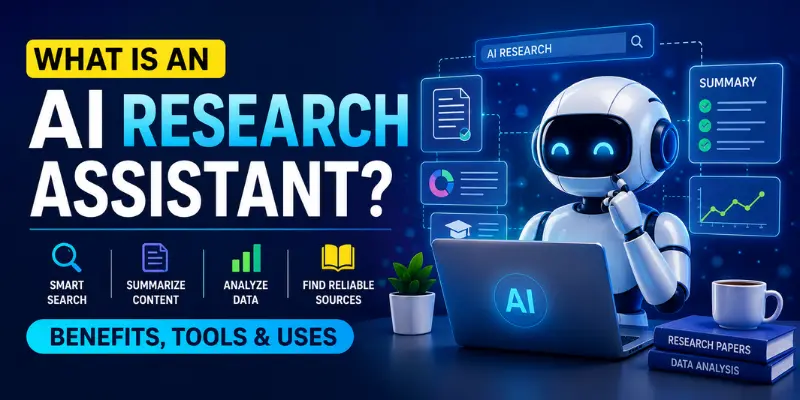
What Is an AI Research Assistant?
An AI research assistant is a software tool that uses artificial intelligence to help users find, analyze, organize, and understand information more efficiently.
Instead of spending hours searching through websites, research papers, reports, books, and databases, users can ask an AI research assistant specific questions and receive relevant information within seconds.
Think of an AI research assistant as a digital helper that supports the research process. It can gather information from multiple sources, summarize lengthy documents, identify important insights, organize notes, and help users discover useful references.
These tools do not replace human researchers. Instead, they reduce repetitive tasks and allow users to focus on critical thinking, analysis, and decision-making.
What Can an AI Research Assistant Do?
AI research assistants can perform a variety of research-related tasks, including:
- Finding relevant information quickly
- Summarising articles and research papers
- Analyzing large amounts of data
- Organising notes and references
- Identifying key insights and trends
- Answering research questions
- Discovering useful sources
- Assisting with literature reviews
- Generating research summaries
- Supporting academic and business research
Simple Example
Imagine a student is writing a paper about artificial intelligence in healthcare.
Instead of manually reading dozens of research papers, the student can use an AI research assistant to:
- Find relevant studies
- Summarize research findings
- Identify common trends
- Organize important notes
- Generate a quick overview of the topic
This allows the student to spend less time searching for information and more time understanding and using it effectively.
Why Is It Called an AI Research Assistant?
The term “research assistant” comes from the role these tools play during the research process.
Just like a human research assistant helps collect information and organize findings, an AI research assistant supports users by handling many time-consuming research tasks automatically.
However, the final analysis, interpretation, and decision-making still depend on human expertise and judgment.
How Does an AI Research Assistant Work?
AI research assistants use artificial intelligence, machine learning, and natural language processing (NLP) to understand user questions, search for relevant information, and present useful results.
Although different tools use different technologies, most AI research assistants follow a similar process.
Information Collection
The first step is gathering information.
When you ask a question or enter a research topic, the AI searches available sources to find relevant information. Depending on the tool, these sources may include:
- Research papers
- Academic journals
- Websites
- Databases
- Reports
- Books
- Online publications
Instead of manually visiting multiple sources, users can access information from a single platform.
Source Analysis
After collecting information, the AI analyzes the content to determine what is most relevant to your query.
The system examines:
- Keywords
- Context
- Topics
- Relationships between concepts
- Source relevance
This helps filter out unnecessary information and prioritize useful results.
Content Summarization
One of the most valuable features of AI research assistants is content summarization.
Research papers and reports can be lengthy and difficult to read. AI tools can review large amounts of text and create concise summaries that highlight the most important points.
This allows users to understand key findings more quickly without reading every page.
Insight Generation
Modern AI research assistants do more than summarize information.
They can also identify patterns, trends, and relationships across multiple sources.
For example, if several research papers discuss the same topic, the AI may highlight:
- Common findings
- Emerging trends
- Frequently discussed challenges
- Areas requiring further research
This helps users gain a broader understanding of the subject.
Research Organization
Managing research materials can become difficult when working with multiple sources.
AI research assistants can help organize:
- Notes
- References
- Citations
- Research papers
- Important findings
Many tools allow users to save information, categorize sources, and revisit previous research sessions.
Answering Research Questions
Most AI research assistants allow users to ask questions in natural language.
For example:
“What are the benefits of artificial intelligence in healthcare?”
Instead of searching manually, the AI provides a direct response based on available information and supporting sources.
This makes research faster and more accessible for beginners.
Continuous Learning and Improvement
Many AI systems continuously improve through machine learning.
As they process more data and user interactions, they become better at understanding questions, finding relevant information, and generating useful responses.
This helps improve the overall research experience over time.
Simple Workflow Example
A typical AI research workflow looks like this:
- Enter a research question.
- AI searches relevant sources.
- The system analyzes the collected information.
- Important findings are summarized.
- Insights and references are presented.
- The user reviews and verifies the results.
This process can significantly reduce the time required for research while helping users access information more efficiently.
Key Features of an AI Research Assistant
AI research assistants include a variety of features that help users find, analyze, and organize information more efficiently. These capabilities reduce manual work and make the research process faster and more productive.
Key Features
- Information Discovery – Finds relevant articles, research papers, reports, and online resources quickly.
- Research Paper Summaries – Generates concise summaries of lengthy academic papers and documents.
- Citation Assistance – Helps identify, organize, and manage references and sources.
- Note Organization – Stores and organizes research notes in a structured manner.
- Question Answering – Provides direct answers to research-related questions using available information.
- Literature Review Support – Helps compare multiple studies and identify common findings.
- Source Recommendations – Suggests related articles, papers, and research materials.
- Trend Identification – Detects patterns, emerging topics, and industry trends.
- Data Analysis Assistance – Supports the interpretation of research data and findings.
- Knowledge Management – Organizes research materials for easier access and review.
- Content Summarization – Simplifies complex information into easy-to-understand insights.
- Collaboration Features – Allows teams to share research findings and work together more effectively.
- Search Across Multiple Sources – Collects information from various databases, publications, and resources.
- Insight Generation – Highlights important findings and connections between different sources.
- Research Workflow Automation – Automates repetitive research tasks to improve productivity.
These features help researchers, students, writers, and professionals complete research tasks more efficiently while focusing on analysis, learning, and decision-making.
Who Uses AI Research Assistants?
AI research assistants are useful for anyone who regularly works with information, research materials, reports, or data. These tools help users find information faster, organize research efficiently, and improve productivity.
Common Users of AI Research Assistants
- Students: Research assignments, projects, and exam preparation.
- Academic Researchers: Literature reviews, paper analysis, and source discovery.
- Writers and Bloggers: Topic research, fact gathering, and content planning.
- Journalists: Information collection, source verification, and trend tracking.
- Business Professionals: Market research, industry analysis, and decision-making.
- Marketing Teams: Audience research, competitor analysis, and content strategy.
- Consultants: Industry research, business reports, and project analysis.
- Product Managers: Customer research, market trends, and product planning.
- Healthcare Professionals: Medical literature reviews and research summaries.
- Educators and Teachers: Lesson preparation, academic research, and knowledge gathering.
The ability to process large amounts of information quickly makes AI research assistants valuable across many industries.
Advantages and Disadvantages of AI Research Assistants
AI research assistants help users find information, summarize content, and organize research more efficiently. They can save time and improve productivity, but they also have certain limitations that users should understand.
Advantages of AI Research Assistants
- Saves time
- Improves productivity
- Speeds up information discovery
- Summarizes lengthy documents quickly
- Organizes research materials efficiently
- Supports literature reviews
- Identifies relevant sources
- Enhances knowledge discovery
- Provides quick answers to research questions
- Assists with data analysis
- Reduces repetitive research tasks
- Supports better decision-making
- Improves research workflow
- Helps manage citations and references
- Encourages continuous learning
Disadvantages of AI Research Assistants
- May generate inaccurate information
- Requires fact-checking
- Cannot replace human expertise
- Limited contextual understanding
- Quality depends on available data
- May reflect bias in source materials
- Potential privacy concerns
- Citation errors can occur
- Over-reliance may reduce research skills
- Limited access to some academic sources
- May misinterpret complex topics
- Subscription costs for premium tools
- Requires internet access
- Not always up to date
- Human review remains necessary
Best AI Research Assistant Tools
Today, several AI-powered research tools help users discover information, analyze sources, summarize content, and organize research more efficiently. Each platform offers different features designed for students, researchers, writers, and business professionals.
Below are some of the best AI research assistant tools available today.
Elicit
Elicit is one of the most popular AI research assistants for academic and evidence-based research. It helps users search research papers, summarize findings, and identify relevant studies.
Key Features:
- Research paper discovery
- AI-generated summaries
- Literature review support
- Evidence-based answers
- Academic research assistance
- Source analysis
Best For: Academic researchers, students, and literature reviews.
Consensus
Consensus is an AI-powered search engine designed to find answers directly from scientific research papers. It focuses on evidence-based information rather than general web content.
Key Features:
- Scientific research search
- Evidence-based answers
- Research paper analysis
- Fast information discovery
- Academic source references
- Research summaries
Best For: Students, researchers, and science-focused research.
Perplexity AI
Perplexity AI combines conversational AI with web search capabilities. It provides direct answers while also citing sources that users can review.
Key Features:
- AI-powered search
- Source citations
- Real-time information retrieval
- Conversational research
- Follow-up questions
- Research summaries
Best For: General research, content creation, and information discovery.
Semantic Scholar
Semantic Scholar is an AI-powered academic search engine developed to help users find high-quality research papers and scientific publications.
Key Features:
- Academic paper search
- Citation analysis
- Research recommendations
- Author tracking
- Scientific literature discovery
- Research insights
Best For: Academic researchers and university students.
Scite
Scite helps users understand how research papers are cited by other studies. It provides citation context rather than simply showing citation counts.
Key Features:
- Smart citation analysis
- Research validation
- Citation context
- Scientific paper evaluation
- Research credibility assessment
- Literature review support
Best For: Researchers who need to evaluate research quality and reliability.
Research Rabbit
Research Rabbit helps users explore research topics visually by showing relationships between papers, authors, and research areas.
Key Features:
- Visual research mapping
- Paper recommendations
- Author discovery
- Citation network analysis
- Research collection management
- Topic exploration
Best For: Literature reviews and discovering related research.
Connected Papers
Connected Papers helps users explore relationships between academic papers using visual graphs. It simplifies the process of discovering relevant studies.
Key Features:
- Visual paper connections
- Related research discovery
- Citation network visualization
- Topic exploration
- Literature review support
- Research trend identification
Best For: Researchers looking to explore related studies and research networks.
Which AI Research Assistant Is Best?
The best AI research assistant depends on your needs.
- Elicit is excellent for literature reviews and academic research.
- Consensus is ideal for evidence-based scientific answers.
- Perplexity AI works well for general research and quick information gathering.
- Semantic Scholar is useful for finding academic papers.
- Scite helps evaluate research quality through citation analysis.
- Research Rabbit is great for discovering related research visually.
- Connected Papers helps users explore research networks and paper relationships.
Many researchers use multiple tools together to create a more efficient research workflow.
Tips for Using AI Research Assistants Effectively
AI research assistants are powerful tools, but using them correctly is essential for obtaining accurate and reliable results.
Best Practices
- Verify Important Information – Always confirm critical facts using trusted sources.
- Check Original Sources – Review the original articles, studies, or reports whenever possible.
- Use Clear Prompts – Specific questions usually generate better results than vague requests.
- Compare Multiple Sources – Avoid relying on a single source for important conclusions.
- Fact-Check AI Responses – AI-generated information may occasionally contain errors.
- Organize Research Findings – Keep notes, references, and summaries structured for future use.
- Use AI as a Research Assistant, Not a Replacement – Human analysis and critical thinking remain essential.
- Review Citations Carefully – Ensure references and source details are accurate.
- Protect Sensitive Information – Avoid sharing confidential or private data with AI tools.
- Combine Multiple Research Tools – Different platforms often provide different strengths and insights.
Common Mistakes to Avoid
- Trusting every AI-generated answer without verification
- Skipping source evaluation
- Ignoring potential bias in AI responses
- Using outdated information without checking publication dates
- Depending entirely on AI for conclusions
- Failing to review original research materials
By following these best practices, users can improve research quality while taking full advantage of the speed and efficiency offered by AI research assistants.
Conclusion
AI research assistants have made the research process faster, easier, and more organized. Instead of spending hours searching for information manually, users can quickly discover sources, summarize content, and manage research materials more efficiently.
However, the best results come when AI is used as a support tool rather than a replacement for human thinking. Successful researchers, students, writers, and professionals use AI to save time while still verifying information, evaluating sources, and applying their own expertise.
As AI technology continues to improve, research assistants will become even more powerful and widely used. Learning how to use these tools effectively today can help you work smarter, stay productive, and make better use of the growing amount of information available online.

- Be Respectful
- Stay Relevant
- Stay Positive
- True Feedback
- Encourage Discussion
- Avoid Spamming
- No Fake News
- Don't Copy-Paste
- No Personal Attacks
- Be Respectful
- Stay Relevant
- Stay Positive
- True Feedback
- Encourage Discussion
- Avoid Spamming
- No Fake News
- Don't Copy-Paste
- No Personal Attacks
