Limited Memory AI – An Overview
Published: 25 Jul 2026
Artificial Intelligence (AI) has become a major part of modern technology. From self-driving cars and virtual assistants to recommendation systems and fraud detection tools, AI is helping businesses and individuals make better decisions every day.
As AI technology continues to evolve, different types of AI systems are being developed to handle various tasks. Some AI systems can only react to current information, while others can use past data to improve their future decisions.
One of the most important and widely used types of artificial intelligence today is Limited Memory AI. It powers many of the smart technologies people interact with daily and plays a key role in advancing modern AI applications.
In this guide, you will learn what Limited Memory AI is, how it works, its key characteristics, real-world examples, advantages, limitations, and why it remains important in 2026.
What Is Limited Memory AI?
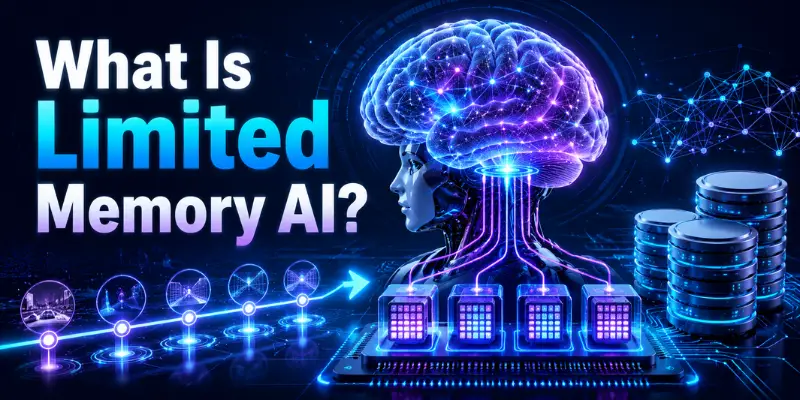
Limited Memory AI is a type of artificial intelligence that can use past data and previous experiences to make better decisions. Unlike reactive machines, it can temporarily store information, analyze historical data, and use that information to improve future actions.
Most modern AI systems, including self-driving cars, virtual assistants, and recommendation engines, are examples of Limited Memory AI.
How Limited Memory AI Works
Limited Memory AI collects and stores relevant information from past events for a specific period. It then analyzes that information along with current data to make more accurate decisions.
Unlike reactive machines that focus only on the present, Limited Memory AI uses both current and historical information.
Simple Process of Limited Memory AI
- Collect current data.
- Store relevant information.
- Analyze past and present data.
- Identify patterns and trends.
- Make informed decisions.
- Update future actions based on new information.
This ability allows the system to adapt to changing situations and improve its performance over time.
Key Characteristics of Limited Memory AI
Here are some characteristics of limited memory
- Uses Historical Data: Stores and analyzes past information.
- Learns From Experience: Improves decisions using previous data.
- Supports Real-Time Decisions: Combines current and past information.
- Adapts to New Situations: Responds to changing environments.
- Requires Data Storage: Maintains temporary memory for analysis.
- Pattern Recognition: Identifies trends and behaviors.
- Improved Accuracy: Makes more informed decisions.
- Dynamic Performance: Adjusts based on new inputs.
- Advanced Decision-Making: Handles complex situations effectively.
- More Flexible Than Reactive AI: Uses experience to improve results.
Examples of Limited Memory AI
Below are some examples of limited memory ai
1. Self-Driving Cars
Self-driving cars are one of the best examples of Limited Memory AI. They use cameras, sensors, GPS, and past driving data to understand road conditions, detect obstacles, and make safe driving decisions in real time.
2. Virtual Assistants
Virtual assistants like Siri, Alexa, and Google Assistant use previous interactions and user preferences to provide more relevant answers and personalized experiences.
3. Recommendation Systems
Platforms such as Netflix, YouTube, and Amazon analyze users’ past activities to recommend movies, videos, and products that match their interests.
4. Fraud Detection Systems
Banks and financial institutions use Limited Memory AI to compare current transactions with historical spending patterns. This helps identify suspicious activities and prevent fraud.
5. Navigation Applications
Apps like Google Maps use real-time traffic information and historical traffic data to suggest faster and more efficient routes.
6. Modern AI Chatbots
Advanced chatbots can remember parts of a conversation and use previous messages to provide more accurate and relevant responses.
7. Predictive Analytics Tools
Businesses use predictive analytics systems to analyze past customer behavior and forecast future trends, sales, and market demands.
8. Healthcare AI Systems
Healthcare platforms use patient history, medical records, and previous test results to assist doctors in diagnosing diseases and recommending treatments.
9. E-Commerce Personalization Systems
Online stores track browsing history and purchase behavior to show personalized product recommendations and improve the shopping experience.
10. Cybersecurity Monitoring Tools
Cybersecurity systems analyze past security incidents and network activity to detect unusual behavior and respond to potential threats more effectively.
Advantages of Limited Memory AI
Here are some benefits of limited memory ai
- Better decision-making
- Improved accuracy
- Learns from past data
- Adapts to changing situations
- Supports automation
- Enhances user experience
- Provides personalized recommendations
- Identifies patterns and trends
- Increases operational efficiency
- Handles large amounts of data
- Improves prediction capabilities
- Reduces human errors
- Supports real-time analysis
- Widely used across industries
- Continuously improves performance
Limitations of Limited Memory AI
Below are some disadvantages of memory AI:
- Limited memory retention
- Depends on data quality
- Privacy and security concerns
- High computing requirements
- Risk of biased outcomes
- Expensive to develop
- Requires regular maintenance
- Complex implementation process
- Cannot fully understand human emotions
- Not truly self-aware
- Vulnerable to inaccurate data
- Requires large datasets
- May produce incorrect predictions
- Needs constant monitoring
- Limited reasoning abilities
Why Limited Memory AI Matters in 2026
Limited Memory AI powers many technologies that people use every day. As businesses generate more data than ever before, AI systems need the ability to learn from historical information and make smarter decisions.
In 2026, organizations will rely on Limited Memory AI to improve customer experiences, automate business operations, detect fraud, optimize logistics, and enhance healthcare services.
Without Limited Memory AI, many modern technologies would lose their ability to adapt and provide personalized experiences.
Its ability to combine historical data with real-time information makes it one of the most practical and valuable forms of artificial intelligence available today.
The Future of Limited Memory AI
Limited Memory AI will continue to evolve as data storage, computing power, and machine learning technologies improve.
Future developments may include:
- More accurate predictions
- Better personalization
- Faster decision-making
- Improved automation
- Enhanced healthcare solutions
- Smarter transportation systems
- Advanced cybersecurity protection
- More efficient business operations
Although researchers are exploring more advanced AI models, Limited Memory AI is expected to remain a key part of artificial intelligence for many years.
Its balance of performance, practicality, and adaptability makes it suitable for a wide range of real-world applications.
Conclusion
So, guys, now you understand Limited Memory AI clearly. Unlike Reactive Machines, Limited Memory AI can use past data to make smarter decisions and improve future outcomes. This capability makes it one of the most widely used forms of artificial intelligence today.
From self-driving cars and virtual assistants to recommendation systems and fraud detection tools, Limited Memory AI powers many technologies that people use every day.
By understanding Limited Memory AI, you can better understand how modern AI systems learn, adapt, and continue to improve over time.
Frequently Asked Questions
It is called Limited Memory AI because it can store and use information for a limited period rather than keeping permanent memories
Many modern AI systems, including advanced chatbots, use limited memory principles to improve responses based on context and previous interactions.

- Be Respectful
- Stay Relevant
- Stay Positive
- True Feedback
- Encourage Discussion
- Avoid Spamming
- No Fake News
- Don't Copy-Paste
- No Personal Attacks
- Be Respectful
- Stay Relevant
- Stay Positive
- True Feedback
- Encourage Discussion
- Avoid Spamming
- No Fake News
- Don't Copy-Paste
- No Personal Attacks
