AI Tools for Startups
Published: 20 Jul 2026
Starting and growing a business is challenging. Most startups work with limited budgets, small teams, and tight deadlines. Founders often handle multiple responsibilities at the same time, including marketing, customer support, sales, content creation, and operations.
This is why many startups are turning to artificial intelligence. AI tools help businesses automate repetitive tasks, improve productivity, and save valuable time. Instead of hiring large teams, startups can use AI software to complete work faster and more efficiently.
In this guide, you’ll discover the best AI tools for startups in 2026 and learn how they can help your business grow.
Why Startups Need AI Tools
Startups need to move fast.
However, limited resources often make growth difficult. AI tools help solve this problem by allowing small teams to accomplish more work in less time.
Some major benefits include the following:
- Save time
- Reduce operational costs
- Improve productivity
- Automate repetitive tasks
- Create content faster
- Improve customer support
- Increase marketing efficiency
- Scale business operations
Many startups now use AI as part of their daily workflow to compete with larger companies.
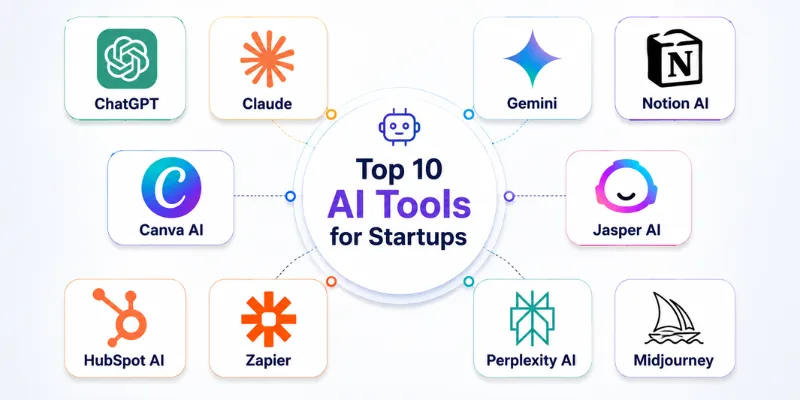
Top 10 AI Tools for Startups in 2026
Here are the top 10 AI tools for startups
1. ChatGPT
ChatGPT is one of the most popular AI tools available today. Many startups use it to create content, write emails, answer customer questions, and generate business ideas.
The tool acts like a virtual assistant that can support multiple departments within a company. Whether you need blog posts, product descriptions, marketing copy, or customer support responses, ChatGPT can help reduce workload and improve efficiency.
Key Features:
- Content creation
- Email drafting
- Research assistance
- Customer support help
- Brainstorming ideas
Best For:
Content marketing, customer support, and general business tasks.
Pros:
- Easy to use
- Saves significant time
- Supports multiple use cases
- Affordable for startups
Cons:
- Can provide inaccurate information
- Requires fact-checking
ChatGPT is a great starting point for startups that want one AI tool capable of handling many different tasks.
2. Claude
Claude is an advanced AI assistant designed for writing, research, and document analysis.
Many startups use Claude when they need detailed responses or help working with long documents. It can summarize reports, review contracts, analyze research papers, and generate professional content.
Its ability to handle large amounts of text makes it especially useful for founders and teams that work with extensive documentation.
Key Features:
- Long document analysis
- Research support
- Content writing
- Text summarization
- Report generation
Best For:
Research, documentation, and long-form content.
Pros:
- Strong writing quality
- Handles large documents well
- Produces natural responses
Cons:
- Premium features require paid plans
Claude is ideal for startups that frequently work with reports, business plans, and detailed documentation.
3. Gemini
Gemini is Google’s AI assistant.
It integrates with Google’s ecosystem and helps users manage emails, documents, spreadsheets, and research tasks more effectively.
Many startups already use Google Workspace, making Gemini a natural addition to their workflow. It can help teams create content, analyze documents, and find information quickly.
Key Features:
- Google Workspace integration
- Research assistance
- Content generation
- Document analysis
- Productivity support
Best For:
Teams using Google products.
Pros:
- Strong Google integration
- Fast information access
- Improves productivity
Cons:
- Some advanced features require subscriptions
Gemini works best for startups that rely heavily on Gmail, Google Docs, and Google Drive.
4. Notion AI
Notion AI combines productivity and artificial intelligence within a single workspace.
Startups use it to organize projects, manage tasks, create notes, and summarize information automatically. Instead of switching between multiple apps, teams can keep everything in one place.
This helps improve organization and collaboration.
Key Features:
- AI summaries
- Task management
- Project planning
- Note organization
- Team collaboration
Best For:
Productivity and project management.
Pros:
- Improves organization
- Supports teamwork
- Easy information management
Cons:
- New users may need time to learn the platform
Notion AI is an excellent choice for startups that want better team coordination and workflow management.
5. Canva AI
Canva AI helps startups create professional designs without hiring a graphic designer. It allows users to generate images, create social media posts, design presentations, and build marketing materials within minutes.
Many startups use Canva AI because it simplifies the design process. Even users with no design experience can create attractive visuals for their business.
Key Features:
- AI image generation
- Social media design
- Presentation creation
- Marketing templates
- Brand kit tools
Best For:
Design and visual content creation.
Pros:
- Beginner-friendly
- Fast design creation
- Large template library
- Affordable pricing
Cons:
- Some advanced features require a paid plan
Canva AI is a great choice for startups that need professional designs without investing in expensive software.
6. Jasper AI
Jasper AI is a marketing-focused AI platform. It helps businesses create blog posts, advertisements, emails, landing pages, and social media content.
Many marketing teams use Jasper because it offers templates specifically designed for business growth. It also helps maintain a consistent brand voice across different content channels.
Key Features:
- Blog writing
- Ad copy generation
- Marketing templates
- Brand voice support
- Content optimization
Best For:
Marketing and content creation.
Pros:
- Built for marketers
- Saves content creation time
- Supports multiple content formats
Cons:
- More expensive than some alternatives
Jasper AI works best for startups that publish content regularly and run marketing campaigns.
7. HubSpot AI
HubSpot AI combines customer relationship management (CRM) with artificial intelligence. It helps startups manage leads, automate marketing tasks, and improve customer engagement.
Instead of using multiple tools, startups can manage sales, marketing, and customer relationships from one platform.
This improves efficiency and keeps business data organized.
Key Features:
- CRM automation
- Lead management
- Email marketing
- Customer insights
- Sales automation
Best For:
Sales and customer management.
Pros:
- All-in-one platform
- Strong automation features
- Easy lead tracking
Cons:
- Advanced plans can be costly
HubSpot AI is ideal for startups that want to improve customer acquisition and sales performance.
8. Zapier
Zapier is one of the most popular automation platforms available today. It connects different applications and automates repetitive tasks.
For example, startups can automatically send leads from a website form to a CRM, save email attachments to cloud storage, or notify team members when new tasks are created.
These automations save time and reduce manual work.
Key Features:
- Workflow automation
- App integrations
- Task automation
- Custom workflows
- Productivity improvement
Best For:
Business automation.
Pros:
- Saves significant time
- Supports thousands of apps
- Easy workflow creation
Cons:
- Complex automations may require setup time
Zapier is perfect for startups that want to automate repetitive business processes.
9. Perplexity AI
Perplexity AI is an AI-powered research tool. Unlike traditional AI chatbots, it provides answers along with source references.
This makes it useful for startups that need reliable information for research, content creation, and decision-making. Many founders use Perplexity AI to quickly gather information without spending hours searching online.
Key Features:
- AI-powered search
- Source citations
- Research assistance
- Real-time information
- Quick answers
Best For:
Research and fact-finding.
Pros:
- Fast research
- Provides sources
- Easy to use
Cons:
- Limited customization options
Perplexity AI is a valuable tool for startups that regularly conduct market research and competitive analysis.
10. Midjourney
Midjourney is one of the leading AI image generation tools. It creates high-quality visuals from simple text prompts.
Startups use Midjourney to create marketing graphics, product concepts, social media visuals, website images, and branding materials. The platform is particularly popular among creative teams because of its impressive image quality.
Key Features:
- AI image generation
- Concept art creation
- Marketing visuals
- Product mockups
- Creative design support
Best For:
Visual content and branding.
Pros:
- High-quality images
- Strong creative capabilities
- Unique visual styles
Cons:
- Requires prompt writing skills
- Learning curve for beginners
Midjourney is an excellent option for startups that need custom visuals without hiring professional designers.
AI Tools Comparison Table
Here is the comparison table between AI tools.
| Tool | Best For | Starting Difficulty |
| ChatGPT | Content & Support | Easy |
| Claude | Research & Documents | Easy |
| Gemini | Productivity | Easy |
| Notion AI | Project Management | Medium |
| Canva AI | Design | Easy |
| Jasper AI | Marketing | Easy |
| HubSpot AI | Sales & CRM | Medium |
| Zapier | Automation | Medium |
| Perplexity AI | Research | Easy |
| Midjourney | Visual Content | Medium |
The best tool depends on your startup’s goals. Many businesses use multiple AI tools together to improve different areas of their operations.
Conclusion
AI tools are becoming essential for modern startups. They help businesses automate tasks, improve productivity, reduce costs, and grow faster with limited resources.
Tools such as ChatGPT, Claude, Gemini, Notion AI, Canva AI, Jasper AI, HubSpot AI, Zapier, Perplexity AI, and Midjourney offer solutions for content creation, marketing, research, customer support, automation, and design.
The best approach is to start with one or two tools that match your business goals. As your startup grows, you can expand your AI toolkit and automate more processes.
By choosing the right AI tools today, startups can save time, improve efficiency, and build a stronger foundation for future growth.

- Be Respectful
- Stay Relevant
- Stay Positive
- True Feedback
- Encourage Discussion
- Avoid Spamming
- No Fake News
- Don't Copy-Paste
- No Personal Attacks
- Be Respectful
- Stay Relevant
- Stay Positive
- True Feedback
- Encourage Discussion
- Avoid Spamming
- No Fake News
- Don't Copy-Paste
- No Personal Attacks
