AI Projects: 25 Best Ideas for Beginners, Students, and Developers (2026)
Published: 26 Jul 2026
Artificial intelligence is changing how people work, learn, and solve problems. From smart chatbots and recommendation systems to AI agents and self-driving technology, AI is becoming part of everyday life.
But reading about AI is not enough. The best way to learn artificial intelligence is by building real AI projects. Projects help you understand how AI models work, how data is used, and how intelligent systems solve real-world problems.
Whether you are a student, beginner, developer, or AI enthusiast, working on AI projects can improve your skills, strengthen your portfolio, and prepare you for future career opportunities.
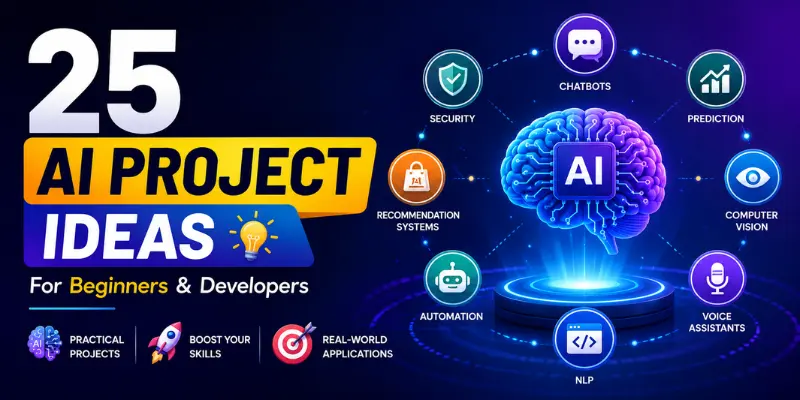
In this guide, you’ll discover the best AI projects, popular project categories, essential tools, and practical ideas you can start building in 2026.
What Are AI Projects?
AI projects are applications, systems, or tools that use artificial intelligence technologies to perform tasks that normally require human intelligence. These tasks may include learning from data, recognizing images, understanding language, making predictions, solving problems, or automating decisions.
AI projects can range from simple beginner applications, such as spam email detection, to advanced systems, such as AI agents, recommendation engines, and generative AI tools.
Quick Comparison of 25 AI Project Ideas
Before starting your first project, it is helpful to compare difficulty levels, technologies, and estimated completion times. The table below provides a quick overview of all 25 AI project ideas covered in this guide.
| AI Project | Difficulty Level | Core Technology | Estimated Time |
| AI Chatbot | Beginner | NLP | 4–8 Hours |
| Movie Recommendation System | Beginner | Machine Learning | 5–8 Hours |
| AI Language Translator | Beginner | NLP | 5–7 Hours |
| Sentiment Analysis Tool | Beginner | Text Classification | 4–6 Hours |
| AI Text Summarizer | Beginner | NLP | 5–8 Hours |
| Resume Screening Tool | Beginner | NLP | 6–8 Hours |
| Handwritten Digit Recognition | Beginner | Computer Vision | 4–6 Hours |
| AI Grammar Checker | Beginner | NLP | 4–6 Hours |
| Personal Finance Assistant | Beginner | Data Analysis | 5–8 Hours |
| Voice Assistant | Intermediate | Speech Recognition | 6–8 Hours |
| Fake News Detector | Intermediate | NLP | 6–8 Hours |
| Image Classification System | Intermediate | Deep Learning | 6–10 Hours |
| Face Recognition Application | Intermediate | Computer Vision | 6–10 Hours |
| Customer Support Chatbot | Intermediate | Conversational AI | 6–8 Hours |
| AI Study Assistant | Intermediate | NLP | 5–8 Hours |
| Smart Expense Tracker | Intermediate | Analytics | 5–7 Hours |
| Stock Price Prediction Model | Intermediate | Predictive Analytics | 8–12 Hours |
| Product Recommendation Engine | Intermediate | Recommendation Systems | 6–10 Hours |
| AI-Powered Content Generator | Intermediate | Generative AI | 5–8 Hours |
| Medical Diagnosis System | Advanced | Healthcare AI | 10–15 Hours |
| Fraud Detection Platform | Advanced | Anomaly Detection | 8–12 Hours |
| Predictive Maintenance System | Advanced | Forecasting Models | 10–15 Hours |
| Smart Traffic Management System | Advanced | Computer Vision | 10–15 Hours |
| AI Cybersecurity Threat Detection Tool | Advanced | Security Analytics | 10–14 Hours |
| Autonomous Vehicle Simulation | Advanced | Reinforcement Learning | 15–20 Hours |
Top 25 AI Projects for Learning Artificial Intelligence
Here are the most important AI project ideas for beginners
1. AI Chatbot
An AI chatbot is one of the most practical artificial intelligence projects for beginners. It can understand user questions and generate relevant responses using natural language processing. This project helps learners understand how conversational AI works and how businesses use chatbots for customer support, lead generation, and user engagement.
Today, AI chatbots are widely used across websites, mobile applications, and messaging platforms to automate communication and improve customer experiences.
1. Project Output: An AI chatbot that can answer user queries and provide automated assistance.
2. Tools Used:
- Python
- OpenAI API
- Dialogflow
- LangChain
3. Data Source: Custom conversation datasets or public chatbot datasets
4. Estimated Time: 4–8 Hours
5. Core Concept: Natural language processing, conversational AI, and prompt engineering.
6. Best For: Beginners interested in chatbots and AI assistants.
2. Movie Recommendation System
A movie recommendation system uses artificial intelligence to suggest movies based on user preferences and viewing history. It is a popular machine learning project because it demonstrates how recommendation algorithms analyze user behavior and predict interests.
Streaming platforms like Netflix and Disney+ use similar AI systems to improve user experiences and increase engagement.
1. Project Output: An AI-powered recommendation engine that suggests relevant movies.
2. Tools Used:
- Python
- Pandas
- Scikit-learn
- TensorFlow
3. Data Source: MovieLens Dataset
4. Estimated Time: 5–8 Hours
5. Core Concept: Recommendation systems, collaborative filtering, and data analysis.
6. Best For: Students learning recommendation algorithms and machine learning.
3. AI Language Translator
An AI language translator converts text from one language into another using machine learning and natural language processing techniques. This project helps learners understand language models, text processing, and multilingual AI applications.
Language translation systems are commonly used in websites, travel applications, international businesses, and communication platforms.
1. Project Output: An AI tool that translates text between multiple languages.
2. Tools Used:
- Python
- Google Translate API
- Hugging Face Transformers
- TensorFlow
3. Data Source: Open multilingual datasets and translation corpora
4. Estimated Time: 5–7 Hours
5. Core Concept: NLP, language models, and machine translation.
6. Best For: Beginners interested in natural language processing and language AI applications.
4. Sentiment Analysis Tool
A sentiment analysis tool uses artificial intelligence to identify emotions and opinions in text. It can determine whether customer reviews, social media comments, or feedback are positive, negative, or neutral. This project helps learners understand how AI analyzes language and extracts meaningful insights from large amounts of text data.
Businesses commonly use sentiment analysis to monitor brand reputation and improve customer satisfaction.
1. Project Output: An AI system that classifies text based on sentiment.
2. Tools Used:
- Python
- NLTK
- TextBlob
- Scikit-learn
3. Data Source: Twitter Sentiment Dataset or IMDb Reviews Dataset
4. Estimated Time: 4–6 Hours
5. Core Concept: Sentiment analysis, NLP, and text classification.
6. Best For: Beginners interested in text analytics and customer feedback analysis.
5. AI Text Summarizer
An AI text summarizer automatically converts lengthy articles, reports, or documents into shorter summaries. This project demonstrates how artificial intelligence processes large amounts of information and extracts the most important points. It is a useful project for learning natural language processing and content automation.
Many AI writing assistants and productivity tools use similar technology to save time and improve information accessibility.
1. Project Output: An AI tool that generates concise summaries from long text.
2. Tools Used:
- Python
- Hugging Face Transformers
- OpenAI API
- TensorFlow
3. Data Source: CNN/DailyMail Dataset
4. Estimated Time: 5–8 Hours
5. Core Concept: Text summarization, NLP, and language models.
6. Best For: Students and beginners learning AI-powered content processing.
6. Resume Screening Tool
A resume screening tool uses artificial intelligence to analyze resumes and match candidates with job requirements. The system can identify relevant skills, experience, and qualifications, helping recruiters save time during the hiring process. This project introduces learners to AI-powered recruitment and document analysis.
Many modern HR platforms use similar AI systems to streamline candidate selection.
1. Project Output: An AI application that evaluates and ranks resumes.
2. Tools Used:
- Python
- SpaCy
- OpenAI API
- Scikit-learn
3. Data Source: Resume datasets from Kaggle
4. Estimated Time: 6–8 Hours
5. Core Concept: Information extraction, NLP, and candidate matching.
6. Best For: Learners interested in HR technology and AI automation. 💕
You have not enough Humanizer words left. Upgrade your Surfer plan.
g complete do
7. Handwritten Digit Recognition
Handwritten digit recognition is a classic AI project that teaches learners how computer vision works. The system analyzes images of handwritten numbers and predicts the correct digit. This project is widely used in AI education because it introduces neural networks and image classification concepts.
Banks, postal services, and educational institutions use similar technology for automated data processing.
1. Project Output: An AI model that recognizes handwritten digits from images.
2. Tools Used:
- Python
- TensorFlow
- Keras
- OpenCV
3. Data Source: MNIST Dataset
4. Estimated Time: 4–6 Hours
5. Core Concept: Computer vision, image recognition, and neural networks.
6. Best For: Beginners interested in deep learning and image processing.
8. AI Grammar Checker
An AI grammar checker helps users identify spelling mistakes, grammar errors, and sentence structure issues. This project demonstrates how natural language processing can improve written communication and automate proofreading tasks.
Many writing assistants use similar AI technology to help users create error-free content.
1. Project Output: An AI tool that detects and corrects writing mistakes.
2. Tools Used:
- Python
- SpaCy
- LanguageTool API
- NLTK
3. Data Source: Public grammar correction datasets
4. Estimated Time: 4–6 Hours
5. Core Concept: NLP, grammar correction, and text analysis.
6. Best For: Students interested in AI writing applications.
9. Personal Finance Assistant
A personal finance assistant uses AI to monitor spending habits, categorize expenses, and provide financial insights. This project teaches learners how AI can analyze user data and generate personalized recommendations.
Many budgeting and financial management applications use similar AI-powered features.
1. Project Output: An AI assistant that tracks and manages personal finances.
2. Tools Used:
- Python
- Pandas
- Scikit-learn
- Streamlit
3. Data Source: Personal finance datasets from Kaggle
4. Estimated Time: 5–8 Hours
5. Core Concept: Data analysis, prediction, and financial automation.
6. Best For: Beginners interested in fintech and AI analytics.
10. Voice Assistant
A voice assistant can understand spoken commands and perform tasks automatically. This project introduces speech recognition, voice processing, and AI automation concepts. It helps learners build systems similar to Siri, Alexa, and Google Assistant.
Voice assistants are widely used in smart devices and business applications.
1. Project Output: An AI assistant that responds to voice commands.
2. Tools Used:
- Python
- SpeechRecognition
- OpenAI API
- PyAudio
3. Data Source: Open speech datasets
4. Estimated Time: 6–8 Hours
5. Core Concept: Speech recognition and conversational AI.
6. Best For: Learners interested in voice-based AI systems.
11. Fake News Detector
A fake news detector uses machine learning to identify misleading or false information. The system analyzes news articles and predicts whether content is reliable. This project helps learners understand text classification and misinformation detection.
Media organizations increasingly use AI tools to combat fake news.
1. Project Output: An AI model that classifies news as real or fake.
2. Tools Used:
- Python
- Scikit-learn
- TensorFlow
- Pandas
3. Data Source: Fake News Dataset from Kaggle
4. Estimated Time: 6–8 Hours
5. Core Concept: NLP, text classification, and machine learning.
6. Best For: Students interested in AI-powered media analysis.
12. Image Classification System
An image classification system identifies and categorizes images automatically. This project introduces computer vision and deep learning concepts while teaching learners how AI understands visual data.
Image classification is widely used in healthcare, security, retail, and manufacturing.
1. Project Output: An AI model that classifies images into categories.
2. Tools Used:
- TensorFlow
- PyTorch
- OpenCV
- Python
3. Data Source: CIFAR-10 Dataset
4. Estimated Time: 6–10 Hours
5. Core Concept: Computer vision and deep learning.
6. Best For: Learners exploring image-based AI applications.
13. Face Recognition Application
A face recognition application identifies individuals using facial features. This project teaches learners how AI analyzes images and matches faces with stored records.
Face recognition technology is commonly used in security systems, smartphones, and access control applications.
1. Project Output: An AI system that recognizes human faces.
2. Tools Used:
- Python
- OpenCV
- Face Recognition Library
- TensorFlow
3. Data Source: Public face datasets
4. Estimated Time: 6–10 Hours
5. Core Concept: Face detection and image recognition.
6. Best For: Students interested in computer vision.
14. Customer Support Chatbot
A customer support chatbot automates responses to customer questions and support requests. It helps businesses provide instant assistance while reducing workload for support teams.
This project demonstrates practical business applications of conversational AI.
1. Project Output: An AI chatbot for customer support.
2. Tools Used:
- OpenAI API
- Dialogflow
- Python
- LangChain
3. Data Source: Customer support conversation datasets
4. Estimated Time: 6–8 Hours
5. Core Concept: NLP and customer service automation.
6. Best For: Learners interested in business AI solutions.
15. AI Study Assistant
An AI study assistant helps students learn by answering questions, explaining concepts, and generating study materials. This project shows how AI can improve education and personalized learning experiences.
Many educational platforms now use AI tutors to support students.
1. Project Output: An AI-powered learning assistant.
2. Tools Used:
- OpenAI API
- Python
- LangChain
- Streamlit
3. Data Source: Educational content datasets
4. Estimated Time: 5–8 Hours
5. Core Concept: Educational AI and knowledge retrieval.
6. Best For: Students and educators interested in AI learning tools.
16. Smart Expense Tracker
A smart expense tracker automatically categorizes spending and provides insights into financial habits. It helps users monitor budgets and identify areas where they can save money.
This project combines AI, analytics, and personal finance management.
1. Project Output: An AI-powered expense management system.
2. Tools Used:
- Python
- Pandas
- Scikit-learn
- Streamlit
3. Data Source: Financial transaction datasets
4. Estimated Time: 5–7 Hours
5. Core Concept: Data analysis and financial prediction.
6. Best For: Learners interested in fintech projects.
17. Stock Price Prediction Model
A stock price prediction model analyzes historical market data to forecast future price movements. This project teaches learners about predictive analytics and time-series forecasting.
Although predictions are not always accurate, the project provides valuable experience in machine learning.
1. Project Output: An AI model that predicts stock market trends.
2. Tools Used:
- Python
- TensorFlow
- Pandas
- Yahoo Finance API
3. Data Source: Historical stock market data
4. Estimated Time: 8–12 Hours
5. Core Concept: Time-series forecasting and predictive analytics.
6. Best For: Intermediate learners interested in financial AI.
18. Product Recommendation Engine
A product recommendation engine suggests products based on user behavior, preferences, and purchase history. This project helps learners understand how e-commerce platforms use AI to improve customer experiences and increase sales.
Online stores like Amazon use recommendation systems to personalize shopping experiences.
1. Project Output: An AI system that recommends relevant products to users.
2. Tools Used:
- Python
- TensorFlow
- Scikit-learn
- Pandas
3. Data Source: Retail datasets or Amazon product datasets
4. Estimated Time: 6–10 Hours
5. Core Concept: Recommendation algorithms and user behavior analysis.
6. Best For: Intermediate learners interested in e-commerce AI.
19. AI-Powered Content Generator
An AI-powered content generator creates articles, social media posts, product descriptions, and marketing content automatically. This project demonstrates how generative AI can assist content creators and businesses.
Many modern AI writing tools use similar technology.
1. Project Output: An AI tool that generates written content from prompts.
2. Tools Used:
- OpenAI API
- Python
- LangChain
- Hugging Face
3. Data Source: Public text datasets and language models
4. Estimated Time: 5–8 Hours
5. Core Concept: Generative AI and natural language generation.
6. Best For: Learners interested in AI writing applications.
20. Medical Diagnosis System
A medical diagnosis system uses AI to analyze symptoms and medical data to assist healthcare professionals. This project helps learners explore how AI supports decision-making in healthcare environments.
AI-powered diagnostic tools can improve accuracy and reduce analysis time.
1. Project Output: An AI model that predicts possible medical conditions.
2. Tools Used:
- Python
- TensorFlow
- Scikit-learn
- Pandas
3. Data Source: Healthcare datasets from Kaggle
4. Estimated Time: 10–15 Hours
5. Core Concept: Predictive analytics and healthcare AI.
6. Best For: Advanced learners interested in medical AI.
21. Fraud Detection Platform
A fraud detection platform identifies suspicious transactions and unusual behavior in financial systems. This project demonstrates how machine learning can help reduce fraud and improve security.
Banks and payment companies use similar AI systems to monitor transactions.
1. Project Output: An AI system that detects potentially fraudulent activities.
2. Tools Used:
- Python
- Scikit-learn
- TensorFlow
- Pandas
3. Data Source: Credit card fraud datasets
4. Estimated Time: 8–12 Hours
5. Core Concept: Anomaly detection and machine learning classification.
6. Best For: Learners interested in fintech and cybersecurity.
22. Predictive Maintenance System
A predictive maintenance system analyzes equipment data to predict failures before they occur. This project helps organizations reduce downtime and maintenance costs.
Manufacturing companies often use predictive AI systems to improve operational efficiency.
1. Project Output: An AI model that predicts equipment maintenance needs.
2. Tools Used:
- Python
- TensorFlow
- Pandas
- IoT Data Sources
3. Data Source: Industrial equipment datasets
4. Estimated Time: 10–15 Hours
5. Core Concept: Predictive analytics and machine learning forecasting.
6. Best For: Advanced learners interested in industrial AI.
23. Smart Traffic Management System
A smart traffic management system uses AI to analyze traffic patterns and optimize signal timings. This project demonstrates how artificial intelligence can improve transportation systems and reduce congestion.
Many smart cities are implementing AI-driven traffic solutions.
1. Project Output: An AI system that manages and optimizes traffic flow.
2. Tools Used:
- Python
- OpenCV
- TensorFlow
- Traffic Simulation Software
3. Data Source: Public traffic datasets
4. Estimated Time: 10–15 Hours
5. Core Concept: Computer vision and real-time decision-making.
6. Best For: Learners interested in smart city technologies.
24. AI Cybersecurity Threat Detection Tool
An AI cybersecurity threat detection tool monitors network activity and identifies suspicious behavior. This project teaches learners how AI can strengthen cybersecurity and detect threats faster than traditional methods.
Organizations use AI security systems to protect networks and sensitive data.
1. Project Output: An AI system that detects cybersecurity threats and anomalies.
2. Tools Used:
- Python
- Scikit-learn
- TensorFlow
- Wireshark
3. Data Source: Network security datasets
4. Estimated Time: 10–14 Hours
5. Core Concept: Threat detection and anomaly analysis.
6. Best For: Advanced learners interested in AI cybersecurity.
25. Autonomous Vehicle Simulation
An autonomous vehicle simulation uses AI to make driving decisions based on environmental data. This project introduces advanced concepts such as computer vision, reinforcement learning, and autonomous systems.
Self-driving car companies use similar technologies to navigate roads and avoid obstacles.
1. Project Output: An AI-powered self-driving vehicle simulation.
2. Tools Used:
- Python
- CARLA Simulator
- TensorFlow
- OpenCV
3. Data Source: Autonomous driving datasets
4. Estimated Time: 15–20 Hours
5. Core Concept: Computer vision, reinforcement learning, and autonomous AI.
6. Best For: Advanced developers interested in self-driving AI systems.
Conclusion
AI projects are among the most effective ways to build practical AI skills and gain real-world experience. From beginner-friendly applications like chatbots and spam detectors to advanced systems such as fraud-detection platforms and autonomous vehicle simulations, every project offers an opportunity to learn something new.
The best approach is to choose a project that matches your current skill level and interests. Beginners should start with simple machine learning and NLP projects, while more experienced learners can explore computer vision, predictive analytics, and generative AI applications.
We recommend focusing on completing one project at a time rather than starting multiple projects simultaneously. A finished project not only improves your technical knowledge but also strengthens your portfolio and demonstrates your abilities to potential employers or clients.
As artificial intelligence continues to grow in 2026 and beyond, hands-on project experience will remain one of the most valuable ways to develop expertise and stay competitive in the AI industry.

- Be Respectful
- Stay Relevant
- Stay Positive
- True Feedback
- Encourage Discussion
- Avoid Spamming
- No Fake News
- Don't Copy-Paste
- No Personal Attacks
- Be Respectful
- Stay Relevant
- Stay Positive
- True Feedback
- Encourage Discussion
- Avoid Spamming
- No Fake News
- Don't Copy-Paste
- No Personal Attacks
