AI contextual governance framework
Published: 26 Jul 2026
Artificial intelligence (AI) is transforming how organizations operate, make decisions, and deliver services. From customer support chatbots to advanced predictive analytics, AI systems are now used across healthcare, finance, education, manufacturing, and many other industries.
However, as AI adoption grows, managing risks, compliance requirements, data privacy, and accountability becomes more challenging. Traditional governance models often apply the same rules to every AI system, regardless of its purpose or risk level. This approach can create governance gaps and reduce operational efficiency.
This is where an AI contextual governance framework becomes important.
An AI contextual governance framework helps organizations apply governance controls based on the specific context, risk level, industry requirements, and intended use of an AI system. Instead of using a one-size-fits-all approach, contextual governance enables businesses to manage AI responsibly while supporting innovation and growth.
In this guide, you’ll learn what an AI contextual governance framework is, how it works, its key components, benefits, challenges, best practices, and future trends in 2026. To understand why governance matters in AI adoption, you can also read our guide on AI Transformation Is a Problem of Governance.
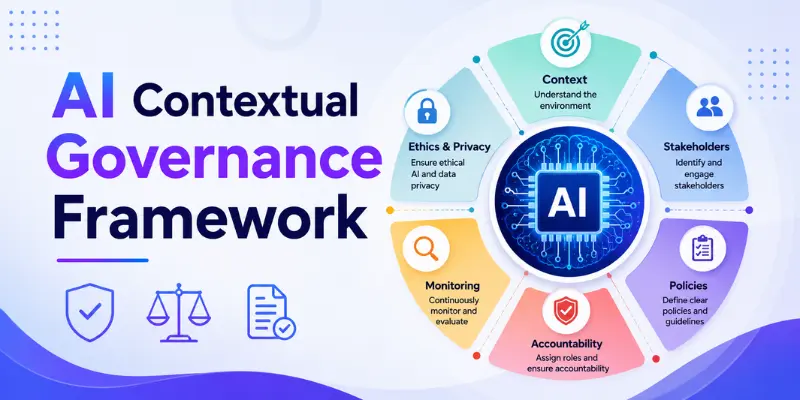
What Is an AI Contextual Governance Framework?
An AI contextual governance framework is a governance model that adapts oversight, policies, and controls according to the context in which an AI system operates.
Rather than treating all AI applications equally, this framework evaluates factors such as:
- AI purpose
- Risk level
- Data sensitivity
- Regulatory requirements
- Industry standards
- Human involvement
This approach allows organizations to apply stronger governance controls to high-risk AI systems while maintaining flexibility for lower-risk applications.
Understanding Contextual AI Governance
Contextual AI governance recognizes that every AI system operates under different conditions and requirements.
For example:
- A healthcare AI system requires strict compliance and oversight.
- A customer support chatbot may require moderate governance controls.
- An internal productivity tool may need minimal governance oversight.
By considering context, organizations can create more effective governance strategies.
Why Traditional AI Governance Is No Longer Enough
Traditional governance frameworks often use standardized policies across all AI applications.
This can lead to:
- Unnecessary restrictions
- Increased compliance costs
- Slower innovation
- Governance inefficiencies
- Poor risk prioritization
Contextual governance solves these challenges by applying controls where they are most needed.
Why AI Governance Needs Context
Organizations use AI in different ways, making context-based governance essential.
Different AI Systems Have Different Risks
Not every AI application creates the same level of risk.
Examples include:
- Low-risk recommendation systems
- Medium-risk customer service AI
- High-risk healthcare diagnostics
- High-risk financial decision systems
Each system requires different governance controls.
Industry-Specific Requirements
Different industries follow different regulations.
Examples include:
- Healthcare privacy regulations
- Financial compliance requirements
- Educational data protection standards
- Government security regulations
Contextual governance helps organizations align with industry-specific requirements.
Human Oversight Requirements
Some AI decisions require human review before action is taken.
Examples include:
- Loan approvals
- Medical recommendations
- Hiring decisions
- Legal assessments
Human oversight reduces risks and improves accountability.
Key Components of an AI Contextual Governance Framework
A successful AI governance framework includes several essential components.
Risk Classification
Risk classification helps organizations determine the level of governance required for each AI system.
Common Risk Categories
- Low-risk AI systems
- Medium-risk AI systems
- High-risk AI systems
- Mission-critical AI applications
Proper risk classification improves governance efficiency.
Data Governance
Data governance ensures AI systems use reliable, secure, and compliant data.
Key Areas
- Data quality
- Data privacy
- Data security
- Data access controls
- Data retention policies
Strong data governance improves AI reliability and compliance.
Human Oversight
Human oversight ensures AI decisions remain accountable and transparent.
Important Controls
- Human review processes
- Approval workflows
- Escalation procedures
- Decision monitoring
- Performance evaluations
Human involvement helps prevent harmful AI outcomes.
Compliance Management
Compliance management ensures AI systems follow applicable regulations and standards.
Governance Requirements
- Regulatory compliance
- Documentation practices
- Internal audits
- External audits
- Reporting procedures
Compliance reduces legal and operational risks.
Accountability and Transparency
Organizations must clearly define responsibility for AI decisions and outcomes.
Core Elements
- Governance policies
- Decision tracking
- Explainable AI practices
- Role assignments
- Responsibility frameworks
Transparency builds trust among stakeholders and users.
How an AI Contextual Governance Framework Works
An AI contextual governance framework follows a structured process to ensure AI systems operate responsibly, securely, and in compliance with regulations.
Step 1: Identify AI Use Cases
The first step is understanding how AI is being used within the organization.
Common AI use cases include:
- Customer service chatbots
- Predictive analytics
- Fraud detection
- Healthcare diagnostics
- Recommendation systems
Each use case may require different governance controls.
Step 2: Assess Risk Levels
Organizations evaluate the potential risks associated with each AI application.
Risk factors may include:
- Data sensitivity
- Decision impact
- Regulatory exposure
- Security concerns
- User safety risks
Risk assessments help determine the appropriate level of oversight.
Step 3: Apply Governance Controls
Governance controls are assigned based on the AI system’s context and risk profile.
Examples include:
- Access restrictions
- Human approval requirements
- Data protection measures
- Compliance checks
- Performance monitoring
This ensures governance efforts remain proportional to risk.
Step 4: Monitor AI Performance
Continuous monitoring helps organizations identify issues before they become serious problems.
Monitoring activities may include:
- Accuracy tracking
- Bias detection
- Compliance reviews
- Security assessments
- User feedback analysis
Ongoing monitoring improves AI reliability and accountability.
Step 5: Review and Update Policies
AI technologies and regulations continue to evolve.
Organizations should regularly:
- Update governance policies
- Review risk classifications
- Improve compliance procedures
- Evaluate governance effectiveness
- Adapt to new regulations
Continuous improvement keeps governance frameworks effective over time.
Benefits of an AI Contextual Governance Framework
An AI contextual governance framework provides several advantages for organizations implementing artificial intelligence.
- Better risk management
- Improved regulatory compliance
- Increased AI transparency
- Stronger data protection
- Better decision-making
- Improved stakeholder trust
- Responsible AI adoption
- Greater operational efficiency
- Reduced governance gaps
- Scalable AI deployment
Organizations that adopt contextual governance can balance innovation with accountability more effectively.
AI Contextual Governance Framework vs Traditional AI Governance
| Factor | AI Contextual Governance Framework | Traditional AI Governance |
| Governance Approach | Adaptive and flexible | Standardized and fixed |
| Risk Management | Risk-based controls | Uniform controls |
| Compliance | Context-specific | Generalized |
| Scalability | Highly scalable | Moderate scalability |
| Decision-Making | Dynamic and responsive | Static and rule-based |
| Resource Allocation | Prioritized by risk | Equal distribution |
| Innovation Support | Encourages flexibility | May slow innovation |
Contextual governance offers a more practical approach for organizations managing diverse AI systems.
Common Challenges of AI Contextual Governance
While contextual governance provides many benefits, organizations may still face implementation challenges.
- Evolving AI regulations
- Data privacy concerns
- Governance complexity
- Limited governance expertise
- AI bias and fairness issues
- Monitoring large AI systems
- Integration challenges
- Resource limitations
- Compliance management difficulties
- Rapid technology changes
Understanding these challenges helps organizations build stronger governance strategies.
Best Practices for Implementing an AI Contextual Governance Framework
Organizations can improve governance effectiveness by following proven best practices.
- Define clear governance objectives
- Classify AI systems based on risk
- Establish accountability structures
- Maintain strong data governance policies
- Conduct regular AI audits
- Monitor AI performance continuously
- Train employees on AI governance
- Document governance decisions
- Use explainable AI techniques
- Update governance policies regularly
- Implement strong security controls
- Align governance with regulations
Following these practices helps ensure responsible and sustainable AI adoption.
Future of AI Contextual Governance Frameworks
As artificial intelligence continues to evolve, contextual governance frameworks will become more advanced and intelligent.
Future trends may include:
- Real-time governance monitoring
- Automated compliance management
- AI-powered risk assessments
- Explainable AI requirements
- Adaptive governance systems
- Industry-specific governance frameworks
- Stronger global AI regulations
- Enhanced transparency standards
- Continuous policy optimization
- Increased governance automation
These developments will help organizations manage AI more effectively while maintaining trust, accountability, and compliance
Conclusion
An AI contextual governance framework helps organizations manage artificial intelligence responsibly by applying governance controls based on risk, context, data sensitivity, and regulatory requirements. Unlike traditional governance models, it provides a flexible approach that adapts to different AI systems and business environments.
As AI adoption continues to accelerate in 2026, organizations must balance innovation with accountability, transparency, security, and compliance. A well-designed contextual governance framework helps reduce risks, improve decision-making, strengthen stakeholder trust, and support responsible AI deployment.
Whether used in healthcare, finance, education, government, or enterprise environments, contextual AI governance enables organizations to build safer, more reliable, and more compliant AI systems. By implementing the right governance strategy today, businesses can prepare for the future of AI while maintaining ethical and sustainable growth.

- Be Respectful
- Stay Relevant
- Stay Positive
- True Feedback
- Encourage Discussion
- Avoid Spamming
- No Fake News
- Don't Copy-Paste
- No Personal Attacks
- Be Respectful
- Stay Relevant
- Stay Positive
- True Feedback
- Encourage Discussion
- Avoid Spamming
- No Fake News
- Don't Copy-Paste
- No Personal Attacks
