Understanding Ai Explainability: Everything You Need To Know
Published: 08 Aug 2026
Artificial intelligence can make decisions, generate predictions, and provide recommendations in seconds. However, many AI systems do not clearly show how they reach those results.
This creates an important question: How does AI make decisions?
When users cannot understand the reasoning behind an AI prediction, they may find it difficult to trust the system. This is especially important in industries such as healthcare, finance, cybersecurity, and hiring, where AI-driven decisions can have a significant impact.
To solve this problem, organizations are focusing on making AI systems more transparent and understandable.
This is where AI explainability becomes important.
AI explainability helps people understand the factors, data, and reasoning behind AI decisions. It allows users to see why an AI model generated a specific prediction or recommendation instead of simply accepting the result.
In this guide, you will learn what AI explainability is, how it works, why it matters, its types, common techniques, benefits, challenges, and real-world applications.
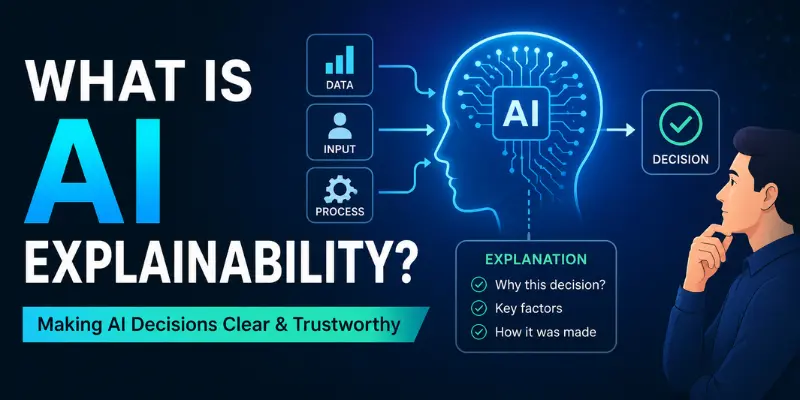
What Is AI Explainability?
AI explainability is the ability to understand and explain how an artificial intelligence system makes decisions, predictions, recommendations, or classifications.
In simple terms, AI explainability helps people understand why an AI model produced a specific result and which factors influenced the outcome.
Instead of acting like a mystery or “black box,” explainable AI provides clear insights into the reasoning behind its decisions. This makes AI systems more transparent, trustworthy, and easier for humans to evaluate.
AI explainability helps answer important questions such as:
- Why did the AI make this decision?
- Which factors influenced the prediction?
- How was the result generated?
- Can the outcome be trusted?
- Is the decision fair and unbiased?
The primary goal of AI explainability is to make artificial intelligence more understandable for users, businesses, regulators, and developers.
Explainable AI vs Black Box AI
Not all AI systems provide explanations for their decisions. Some models are transparent, while others operate as black boxes.
| Type | Description |
| Explainable AI (XAI) | Provides clear and understandable explanations for decisions and predictions. |
| Black Box AI | Generates results without clearly showing how decisions were made. |
Many advanced machine learning and deep learning models fall into the black-box category, making AI explainability increasingly important.
Why AI Explainability Is Important
As artificial intelligence becomes more involved in healthcare, finance, cybersecurity, education, and business operations, organizations need greater visibility into how AI systems work.
AI explainability helps organizations:
- Understand AI decision-making
- Improve transparency
- Build trust in AI systems
- Detect bias and unfair outcomes
- Increase accountability
- Support regulatory compliance
- Improve decision quality
- Promote responsible AI adoption
By making AI systems easier to understand, explainability helps ensure that artificial intelligence remains reliable, ethical, and trustworthy.
How Does AI Explainability Work?
AI explainability works by showing how an artificial intelligence system reaches a decision, prediction, recommendation, or outcome. Instead of only displaying the final result, explainable AI reveals the factors and data that influenced the decision.
Most AI systems follow a step-by-step process that makes their outputs easier to understand.
1. Data Input
The AI system receives data from one or more sources.
Examples of Input Data:
- Customer information
- Medical records
- Financial data
- Images
- Documents
- Sensor data
- User behavior
The quality of this data directly affects the accuracy of AI predictions.
2. Data Analysis and Processing
The AI model analyzes the input data using machine learning algorithms and statistical techniques.
During this stage, the system:
- Identifies patterns
- Finds relationships
- Detects trends
- Compares historical data
- Learns from previous examples
This is where the AI performs most of its decision-making work.
3. Prediction or Decision Generation
After analyzing the data, the AI generates an output.
Common Outputs Include:
- Recommendations
- Predictions
- Classifications
- Risk scores
- Automated decisions
For example, an AI system may predict whether a customer is likely to purchase a product or whether a loan application should be approved.
4. Identifying Important Factors
AI explainability highlights the factors that had the greatest influence on the result.
Examples of Important Factors:
- Credit score
- Income level
- Purchase history
- Medical conditions
- Previous transactions
- Customer behavior
This helps users understand why the AI produced a specific outcome.
5. Providing Human-Friendly Explanations
Explainable AI converts complex calculations into simple explanations that humans can understand.
For example, instead of displaying technical algorithms, the system may explain:
- Low credit score affected the loan decision.
- Unusual account activity triggered a fraud alert.
- High-risk medical indicators influenced the diagnosis.
These explanations make AI decisions more transparent and trustworthy.
6. Supporting Review and Validation
Users can review AI explanations to determine whether the decision is reasonable, accurate, and fair.
This step helps organizations:
- Detect errors
- Identify bias
- Improve transparency
- Increase accountability
- Build trust in AI systems
Why AI Explainability Matters
Without explainability, AI decisions may appear random or difficult to trust.
By showing how decisions are made, AI explainability helps:
- Improve transparency
- Build user trust
- Detect bias
- Reduce errors
- Support accountability
- Meet regulatory requirements
- Promote responsible AI adoption
This is why AI explainability has become a critical part of modern artificial intelligence systems.
Key Features of AI Explainability
AI explainability includes several features that help users understand, evaluate, and trust AI-generated decisions.
- Transparency – Reveals how AI systems reach conclusions.
- Interpretability – Makes AI decisions easier for humans to understand.
- Accountability – Supports responsibility for AI-generated outcomes.
- Fairness – Helps ensure decisions are unbiased and ethical.
- Bias Detection – Identifies unfair patterns within AI models.
- Traceability – Tracks the factors influencing predictions.
- Decision Justification – Explains why a specific result was generated.
- Model Monitoring – Supports ongoing evaluation of AI performance.
- Risk Assessment – Helps identify potential issues and weaknesses.
- Human Understanding – Converts complex processes into understandable explanations.
- Compliance Support – Assists organizations in meeting regulatory requirements.
- Trust Building – Increases confidence in AI-driven systems.
These features work together to create more transparent and responsible artificial intelligence systems.
Types of AI Explainability
AI explainability is not limited to a single method. Different types of AI explainability focus on different aspects of how artificial intelligence systems make decisions.
Understanding these explainability approaches helps organizations select the right method based on their AI models, business goals, and transparency requirements.
1. Global Explainability
Global explainability focuses on understanding how an entire AI model works.
Instead of explaining a single prediction, it explains the overall decision-making process of the model.
Example:
A bank analyzes the factors its AI loan approval system uses when evaluating all applicants.
Best For:
- Understanding overall model behavior
- AI governance
- Regulatory compliance
2. Local Explainability
Local explainability focuses on explaining a specific AI prediction or decision.
It helps users understand why a particular outcome occurred.
Example Questions:
- Why was this loan rejected?
- Why was this transaction flagged?
- Why was this patient classified as high risk?
Best For:
- Individual predictions
- Customer-facing explanations
- Decision reviews
3. Model-Specific Explainability
Model-specific explainability techniques are designed for particular machine learning algorithms.
These methods take advantage of a model’s internal structure to provide explanations.
Examples:
- Decision Trees
- Linear Regression
- Random Forests
Best For:
- Interpretable machine learning models
- Structured AI systems
- Transparent decision-making
4. Model-Agnostic Explainability
Model-agnostic explainability works with almost any AI model, regardless of its architecture.
These techniques explain predictions without requiring access to the model’s internal structure.
Examples:
- SHAP
- LIME
Best For:
- Complex machine learning models
- Deep learning systems
- Cross-model explainability
5. Intrinsic Explainability
Intrinsic explainability refers to AI models that are naturally easy to understand.
Users can directly observe how decisions are made without additional explanation tools.
Examples:
- Decision Trees
- Rule-Based Systems
- Linear Regression Models
Best For:
- High transparency requirements
- Simple AI applications
- Regulatory environments
6. Post-Hoc Explainability
Post-hoc explainability is applied after an AI model generates a prediction.
Specialized techniques are used to explain decisions without modifying the underlying model.
Examples:
- SHAP Explanations
- LIME Explanations
- Feature Importance Analysis
Best For:
- Deep learning models
- Neural networks
- Complex AI systems
AI Explainability Types Comparison
| Type | Focus | Best Use Case |
| Global Explainability | Entire model behavior | Model understanding |
| Local Explainability | Individual predictions | Decision explanations |
| Model-Specific Explainability | Specific algorithms | Transparent models |
| Model-Agnostic Explainability | Any AI model | Complex systems |
| Intrinsic Explainability | Naturally interpretable models | High transparency |
| Post-Hoc Explainability | Explaining completed predictions | Deep learning models |
Which Type of AI Explainability Is Best?
There is no single best type of AI explainability.
The right approach depends on:
- AI model complexity
- Business requirements
- Regulatory obligations
- User expectations
- Transparency goals
Many organizations combine multiple explainability methods to improve trust, transparency, and understanding of their AI systems.
Common AI Explainability Techniques
AI explainability relies on several techniques that help users understand how machine learning models make decisions. These methods reveal the factors that influence predictions and improve transparency in artificial intelligence systems.
1. Feature Importance
Feature importance identifies which variables have the greatest impact on an AI model’s prediction.
Common Factors Include:
- Credit score
- Income level
- Purchase history
- Medical records
- Customer behavior
This technique helps users understand which inputs influence AI decisions the most.
2. SHAP (SHapley Additive Explanations)
SHAP is one of the most popular AI explainability techniques. It measures how much each feature contributes to a specific prediction.
Key Benefits:
- Works with multiple AI models
- Provides detailed explanations
- Identifies influential variables
- Improves model transparency
3. LIME (Local Interpretable Model-Agnostic Explanations)
LIME explains individual AI predictions by creating simpler models around specific outcomes.
Key Benefits:
- Easy-to-understand explanations
- Compatible with complex AI models
- Explains individual decisions
- Supports local explainability
4. Decision Trees
Decision trees are naturally explainable because users can follow the decision path from start to finish.
Key Advantages:
- Easy visualization
- Transparent decision-making process
- Human-readable logic
- Simple interpretation
5. Rule-Based Systems
Rule-based systems use predefined rules to generate decisions.
Example:
If a customer’s income exceeds a specific amount and their credit score meets the required threshold, the loan application may be approved.
These systems are among the most interpretable AI approaches.
6. Counterfactual Explanations
Counterfactual explanations show what changes could lead to a different outcome.
Example:
A loan applicant may receive the following explanation:
“If your credit score increased by 50 points, your application would likely be approved.”
This helps users understand how outcomes can change.
7. Partial Dependence Plots (PDPs)
Partial dependence plots visualize how individual features affect AI predictions.
Key Benefits:
- Shows feature influence
- Reveals variable relationships
- Improves model understanding
- Supports explainability analysis
Why These AI Explainability Techniques Matter
These techniques help organizations:
- Improve transparency
- Build trust in AI systems
- Detect bias and unfair outcomes
- Understand model behavior
- Support regulatory compliance
- Encourage responsible AI adoption
As AI systems become more advanced, explainability techniques play an increasingly important role in making artificial intelligence more transparent, trustworthy, and accountable.
Benefits of AI Explainability
AI explainability provides significant advantages for organizations, developers, regulators, and end users. By making AI systems easier to understand, explainability helps improve trust, transparency, and decision quality.
- Builds user trust
- Improves transparency
- Supports ethical AI
- Detects bias
- Enhances accountability
- Improves decision-making
- Supports regulatory compliance
- Reduces risk
- Increases user confidence
- Improves model monitoring
- Supports human oversight
- Encourages responsible innovation
- Promotes fairness
- Strengthens AI governance
- Improves model reliability
By improving understanding and transparency, AI explainability helps organizations use artificial intelligence more responsibly and effectively.
Challenges and Limitations of AI Explainability
Although AI explainability offers many advantages, implementing it can be difficult, especially for advanced machine learning models.
- Complex AI models
- Technical complexity
- Accuracy vs explainability trade-off
- Resource requirements
- Lack of standardization
- Human interpretation challenges
- Scalability issues
- Implementation costs
- Regulatory uncertainty
- Incomplete explanations
- Data quality issues
- Model maintenance challenges
- Integration difficulties
- Limited transparency in deep learning
- Evolving compliance requirements
Organizations must balance explainability, performance, and practicality when developing AI solutions.
Where Is AI Explainability Used?
AI explainability is becoming increasingly important across industries where artificial intelligence influences critical decisions. Organizations use explainable AI to improve transparency, build trust, and ensure responsible decision-making.
- Healthcare: Disease diagnosis, medical imaging analysis, patient risk assessment, and treatment recommendations.
- Banking and Finance: Loan approvals, credit scoring, fraud detection, and financial risk analysis.
- Insurance: Claims assessment, policy pricing, underwriting decisions, and risk evaluation.
- Cybersecurity: Threat detection, malware analysis, network monitoring, and security investigations.
- Human Resources: Candidate screening, recruitment decisions, employee evaluations, and workforce analytics.
- Retail and E-Commerce: Product recommendations, customer segmentation, demand forecasting, and personalized shopping experiences.
- Manufacturing: Predictive maintenance, quality control, equipment monitoring, and production optimization.
- Government Services: Benefit eligibility decisions, public service automation, compliance monitoring, and risk assessments.
- Autonomous Vehicles: Route planning, object detection, driving behavior analysis, and safety decision-making.
- Education: Student performance analysis, personalized learning recommendations, and academic support systems.
- Telecommunications: Network optimization, customer support automation, and service quality monitoring.
- Legal Services: Document analysis, legal research assistance, and risk assessment
Best AI Explainability Tools
Several tools help organizations understand, monitor, and explain AI model behavior. These platforms improve transparency and make AI systems easier to evaluate.
1. IBM Watson OpenScale
IBM Watson OpenScale helps organizations monitor AI models for fairness, bias, and explainability.
Key Features:
- AI monitoring
- Bias detection
- Model explainability
- Performance tracking
Best For: Enterprise AI governance.
2. Google Explainable AI
Google Explainable AI provides tools that help users understand machine learning predictions.
Key Features:
- Feature attribution
- Model analysis
- Prediction explanations
- Integration with Google Cloud
Best For: Machine learning projects on Google Cloud.
3. Microsoft InterpretML
InterpretML is an open-source explainable AI framework developed by Microsoft.
Key Features:
- Model interpretability
- Explainable machine learning
- Feature importance analysis
- Visualization tools
Best For: Data scientists and AI developers.
4. SHAP
SHAP is one of the most widely used explainability frameworks.
Key Features:
- Feature importance analysis
- Local explanations
- Global explanations
- Model-agnostic support
Best For: Explaining machine learning predictions.
5. LIME
LIME helps explain individual predictions made by complex AI systems.
Key Features:
- Local explanations
- Model-agnostic functionality
- Easy interpretation
- Prediction analysis
Best For: Explaining specific AI decisions.
6. Fiddler AI
Fiddler AI focuses on AI monitoring and explainability for enterprise applications.
Key Features:
- Model monitoring
- Explainability dashboards
- Bias detection
- Performance tracking
Best For: Large organizations managing production AI systems.
7. WhyLabs
WhyLabs provides AI observability and model monitoring tools.
Key Features:
- Data monitoring
- Drift detection
- Explainability support
- AI performance analysis
Best For: Maintaining reliable AI systems.
Best Practices for Implementing AI Explainability
Organizations can improve AI transparency by following established explainability practices.
- Use transparent models when possible
- Document AI decision-making processes
- Monitor model performance regularly
- Test systems for bias
- Keep humans involved in important decisions
- Provide clear explanations for predictions
- Review AI outputs frequently
- Maintain compliance standards
- Educate teams about explainable AI
- Continuously improve AI systems
Following these practices helps create more trustworthy and responsible AI solutions.
Conclusion
AI explainability is becoming one of the most important aspects of modern artificial intelligence. As AI systems continue to influence decisions in healthcare, finance, cybersecurity, education, and many other industries, people increasingly want to understand how those decisions are made.
By making AI systems more transparent and understandable, explainability helps build trust, improve accountability, reduce bias, and support responsible AI adoption. It allows organizations to move beyond simply using AI and focus on creating systems that users can confidently understand and evaluate.
While challenges still exist, advancements in explainability tools, regulations, and best practices are making AI more accessible and trustworthy. Organizations that prioritize explainability today will be better prepared for the future of responsible artificial intelligence.
As AI continues to evolve, explainability will remain a key factor in ensuring that intelligent systems are not only powerful but also fair, transparent, and beneficial for everyone.

- Be Respectful
- Stay Relevant
- Stay Positive
- True Feedback
- Encourage Discussion
- Avoid Spamming
- No Fake News
- Don't Copy-Paste
- No Personal Attacks
- Be Respectful
- Stay Relevant
- Stay Positive
- True Feedback
- Encourage Discussion
- Avoid Spamming
- No Fake News
- Don't Copy-Paste
- No Personal Attacks
