How to Use AI Writing Tools for Blogging in 2026
Published: 06 Aug 2026
Many beginners hear that AI can help with blogging, but they are often unsure where to start. Some believe AI writing tools are only useful for writing articles, while others worry that using them might make their content look robotic or low-quality.
The truth is that AI writing tools can help with much more than content writing.
Bloggers use AI to find topic ideas, perform keyword research, create outlines, write drafts, improve SEO, edit content, and even promote published articles on social media. When used correctly, AI can save time, increase productivity, and make the blogging process much easier.
However, AI is not a replacement for human creativity and expertise. The most successful bloggers use AI as an assistant that helps them work faster while still adding their own knowledge, experience, and personal insights.
In this beginner-friendly guide, you will learn exactly how to use AI writing tools for blogging. We will cover practical examples, ready-to-use prompts, and real blogging tasks so you can confidently use AI throughout your content creation workflow.
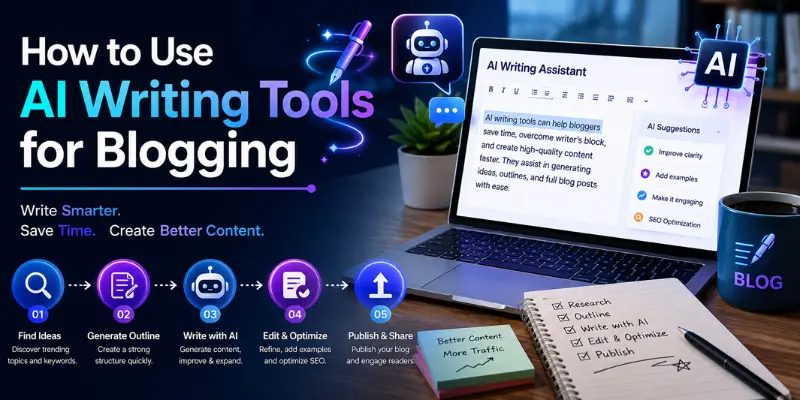
What Are AI Writing Tools?
AI writing tools are software applications that use artificial intelligence to help create, improve, and organise written content. These tools understand your instructions, called prompts, and generate content based on the information you provide.
Think of an AI writing tool as a smart writing assistant. Instead of spending hours brainstorming ideas or creating outlines from scratch, you can ask the tool for help and receive suggestions within seconds.
Many bloggers use AI writing tools to speed up their workflow and improve productivity. However, the best results come when AI works alongside human creativity rather than replacing it.
Popular AI Writing Tools
Some of the most popular AI writing tools include:
- ChatGPT
- Jasper AI
- Copy.ai
- Writesonic
- Grammarly
- Rytr
- Notion AI
What Can AI Writing Tools Do for Bloggers?
AI writing tools can help with:
- Generating blog topic ideas
- Finding content angles
- Creating article outlines
- Writing introductions and drafts
- Generating FAQs
- Improving grammar and readability
- Creating meta titles and descriptions
- Writing social media captions
- Repurposing existing content
How to Use AI Writing Tools for Blogging
AI writing tools can help during every stage of blogging. Most beginners think AI is only useful for writing articles, but successful bloggers use AI for research, planning, SEO, content creation, editing, and promotion.
Let’s explore how bloggers use AI writing tools step by step.
1. Use AI for Blog Topic Research
The first step in blogging is choosing a topic people want to read about. Many beginners spend hours trying to come up with content ideas. AI can generate dozens of blog topics within seconds.
“Suggest 30 beginner-friendly blog topics about artificial intelligence for a new AI website.”
Example Output:
- What Is AI Scalability?
- Is AI Easy to Learn?
- What Is AI Transparency?
- Benefits of Artificial Intelligence
- Objectives of Artificial Intelligence
Now you have multiple content ideas instead of staring at a blank screen. You can save these ideas for your content calendar.
Pro Tip:
Choose topics that match your audience’s interests and your website’s niche.
2. Use AI for Keyword Research
After selecting a topic, the next step is finding keywords. Keywords help search engines understand your content and connect it with relevant users.
AI can generate related keywords, long-tail keywords, and common questions.
“Give me related keywords, long-tail keywords, and FAQs for the keyword ‘AI writing tools for blogging’.”
Example Output:
Related Keywords
- AI blogging tools
- AI content writing tools
- AI content generator
- AI writing assistant
Long-Tail Keywords
- How to use AI for blogging
- Best AI writing tools for beginners
- AI content creation for blogs
FAQs
- Can AI write blog posts?
- Is AI content good for SEO?
- Which AI writing tool is best for blogging?
These suggestions help you create more comprehensive content.
Pro Tip:
Use keywords naturally. Focus on helping readers rather than repeating keywords unnecessarily.
3. Use AI for Competitor Research
Before writing an article, it is useful to understand what top-ranking content already covers. AI can help identify common topics and content gaps.
“What topics do top-ranking articles about AI writing tools for blogging usually cover?”
Example Output:
- Benefits of AI writing tools
- Blogging workflow
- SEO optimization
- Popular AI tools
- Common mistakes
Now compare these topics with your planned outline.
If competitors discuss benefits but do not explain real prompts or practical examples, you can add those sections to create a better article.
Pro Tip:
Never copy competitors. Use their content solely to understand user expectations and identify opportunities to deliver more value.
3. Use AI for Creating Blog Outlines
A detailed outline acts as a roadmap for your article. Instead of wondering what to write next, you can follow a structured plan.
“Create a detailed SEO-friendly outline for an article about AI writing tools for blogging.”
Example Output:
- Introduction
- What Are AI Writing Tools?
- Benefits of AI Writing Tools
- How to Use AI Writing Tools for Blogging
- Common Mistakes
- FAQs
- Conclusion
A strong outline improves content organization and readability.
Pro Tip:
Review the outline and add any sections that match your audience’s needs.
4. Use AI for Writing First Drafts
Once the outline is ready, AI can help generate the first draft. However, avoid asking AI to write the entire article in a single prompt. Generate content section by section instead.
“Write a beginner-friendly introduction for an article about AI writing tools for blogging using simple English.”
Example Output:
AI may generate an introduction explaining how bloggers use AI to create content faster and improve productivity.
You can then edit the text and add your own style.
Pro Tip:
Treat AI-generated content as a starting point, not a finished article.
5. Use AI for Adding Personal Insights and Examples
This is where your content becomes unique. AI can provide information, but your experience makes the article more helpful and trustworthy.
“Suggest practical examples of how bloggers use AI writing tools in their daily workflow.”
You can combine AI suggestions with your own experiences.
Example:
Instead of writing:
“AI writing tools save time.”
Write:
“I use AI writing tools to create article outlines in a few minutes. This allows me to spend more time on keyword research and SEO optimization.”
Pro Tip:
Always add real examples whenever possible. Readers trust practical experience more than generic statements.
6. Use AI for Creating Featured Image Prompts
Visual content is an important part of blogging. AI can help generate detailed prompts for featured images.
“Create an 800×400 featured image prompt for an article titled ‘How to Use AI Writing Tools for Blogging’.”
Example Output:
A modern workspace with a laptop displaying AI-generated content, blogging icons, SEO symbols, content planning graphics, and a clean professional design. You can use this prompt with image generation tools.
Pro Tip:
Include your article title and target audience when generating image prompts.
7. Use AI for SEO Optimization
AI can assist with many on-page SEO tasks.
AI Can Help Create:
- Meta titles
- Meta descriptions
- FAQs
- Internal linking ideas
- Related keyword suggestions
- Schema-friendly questions
“Create an SEO title and meta description for an article about AI writing tools for blogging.”
Example Output:
Meta Title:
How to Use AI Writing Tools for Blogging (Beginner Guide)
Meta Description:
Learn how to use AI writing tools for blogging. Discover practical tips, prompts, and SEO strategies to create better content.
Pro Tip:
Always review AI-generated SEO elements before publishing.
8. Use AI for Editing and Proofreading
Even experienced bloggers make mistakes. AI can help improve grammar, readability, and sentence structure.
“Improve readability and convert this paragraph into active voice.”
Example Output:
AI rewrites the content using shorter sentences and clearer language.
This helps make your article easier to understand.
Pro Tip:
Use AI to improve clarity, but do not remove your natural writing style.
9. Use AI for Social Media Promotion
Publishing a blog post is only part of the process. You also need to promote your content. AI can generate social media posts for multiple platforms.
“Create a LinkedIn post promoting my article about AI writing tools for blogging.”
Example Output:
A short promotional post highlighting the article’s key benefits and encouraging readers to visit the blog.
You can also create content for:
- X (Twitter)
Pro Tip:
Customize each post for the platform where it will be published.
10. Use AI for Updating Old Blog Posts
Content updates help maintain rankings and keep articles relevant. AI can suggest improvements and identify outdated information.
“Update this article with the latest AI trends and examples for 2026.”
Example Output:
AI may suggest new tools, updated statistics, and recent industry developments. You can then review the recommendations and update your content.
Pro Tip:
Review important facts manually before updating published articles.
Benefits of Using AI Writing Tools for Blogging
AI writing tools offer several advantages for bloggers.
Key Benefits
- Save time during content creation
- Generate topic ideas quickly
- Reduce writer’s block
- Improve productivity
- Create outlines faster
- Assist with SEO optimization
- Improve grammar and readability
- Generate FAQs and metadata
- Help create social media content
- Simplify content updates
When combined with human expertise, AI can significantly improve the blogging process.
Common Mistakes Beginners Should Avoid
AI can be extremely useful, but many beginners misuse these tools.
Avoid These Mistakes
- Publishing AI-generated content without editing
- Trusting every fact generated by AI
- Using vague prompts
- Ignoring keyword research
- Overusing AI-generated text
- Forgetting to add personal insights
- Skipping proofreading
- Creating content only for search engines
These mistakes can reduce content quality and hurt user experience.
Best Practices for Using AI Writing Tools
Following best practices will help you get better results.
Recommended Practices
- Use clear and specific prompts
- Generate content section by section
- Fact-check important information
- Add real examples and experiences
- Focus on user intent
- Edit AI-generated content carefully
- Keep your writing simple and clear
- Update articles regularly
The best bloggers use AI as a helper, not as a replacement for their expertise.
Conclusion
So far, you have learned how AI writing tools can support every stage of blogging, from topic research and keyword planning to content creation, SEO optimization, and promotion.
The most successful bloggers do not use AI to replace their skills. Instead, they use it to save time, improve productivity, and make better content decisions.
My recommendation is to start with simple tasks such as topic research, outline creation, and content editing. As you become more comfortable, you can use AI for advanced blogging activities such as SEO optimization and content planning.
When you combine AI assistance with human creativity, personal experience, and careful editing, you can create blog posts that are both helpful to readers and valuable for search engines.

- Be Respectful
- Stay Relevant
- Stay Positive
- True Feedback
- Encourage Discussion
- Avoid Spamming
- No Fake News
- Don't Copy-Paste
- No Personal Attacks
- Be Respectful
- Stay Relevant
- Stay Positive
- True Feedback
- Encourage Discussion
- Avoid Spamming
- No Fake News
- Don't Copy-Paste
- No Personal Attacks
