Objectives of AI
Published: 03 Aug 2026
Artificial Intelligence (AI) is one of the most important technologies of the modern world. Businesses, schools, hospitals, and many other industries use AI to improve their operations and solve problems more efficiently.
However, many people focus on what AI can do without understanding why it was created. Before learning advanced AI concepts, it is important to understand the objectives of AI.
In simple words, the objectives of AI are the goals that researchers and organizations want to achieve through intelligent systems. These objectives guide the development of AI technologies and help explain their role in the real world.
In this guide, you will learn the main objectives of AI, why they matter, and how organizations use them today.
What Are the Objectives of AI?
The objectives of AI are the primary goals that artificial intelligence systems are designed to achieve.
These goals focus on creating machines capable of performing tasks that require human intelligence, such as learning, reasoning, problem-solving, decision-making, and communication.
Simply put, AI aims to make machines smarter, more adaptable, and more capable of assisting humans.
Why Was AI Created?
Researchers created AI to help machines perform tasks that normally require human thinking.
Humans often spend significant time analyzing information, solving problems, and making decisions. AI helps handle these tasks more efficiently by processing large amounts of data and identifying useful patterns.
The goal of AI is not to replace humans completely. Instead, it aims to support human capabilities and improve how people work and interact with technology.
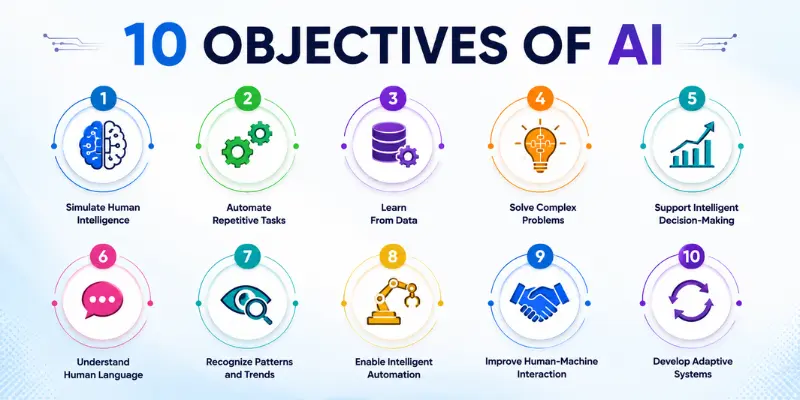
10 Main Objectives of AI
Here are the main objectives of ai
1. Simulate Human Intelligence
One of the primary objectives of AI is to simulate human intelligence. Researchers developed AI to perform tasks that normally require human thinking, reasoning, learning, and decision-making. Instead of simply following pre-programmed instructions, AI systems can analyze information, recognize patterns, and generate intelligent responses.
This objective helps machines perform complex tasks more effectively and creates opportunities for smarter technologies. It also serves as the foundation for many AI applications used today.
AI helps to:
- Mimic human reasoning and thinking
- Analyze information intelligently
- Make logical decisions
- Learn from previous experiences
Example: Virtual assistants such as Siri and Google Assistant can understand questions and provide relevant responses.
2. Automate Repetitive Tasks
Another major objective of AI is to automate repetitive and time-consuming tasks. Many organizations spend significant resources on routine activities that require little creativity or human judgment. AI helps reduce this workload by handling such tasks automatically.
By automating routine work, businesses can save time, improve efficiency, and allow employees to focus on higher-value activities. This objective has become one of the biggest drivers of AI adoption across industries.
AI helps to:
- Reduce manual effort
- Speed up routine processes
- Handle repetitive operations
- Improve workflow efficiency
Example: AI chatbots answer customer inquiries automatically without requiring human support for every request.
3. Learn From Data
One of the most important objectives of AI is the ability to learn from data. Unlike traditional software that follows fixed rules, AI systems analyze large amounts of information and improve their performance over time.
This learning process allows AI to identify patterns, predict outcomes, and make more accurate decisions. The more relevant data an AI system receives, the better it becomes at performing its tasks.
AI helps to:
- Analyze historical information
- Identify useful patterns
- Improve predictions
- Adapt to new data
Example: Netflix recommends movies and shows based on a user’s viewing history and preferences.
4. Solve Complex Problems
AI was created to help solve problems that may be difficult, time-consuming, or impossible for humans to solve quickly. Many modern challenges involve massive datasets and complicated relationships that require advanced analysis.
AI can process information much faster than humans and uncover insights that might otherwise remain hidden. This objective makes AI valuable in research, healthcare, finance, and many other industries.
AI helps to:
- Analyze large datasets
- Identify hidden relationships
- Generate possible solutions
- Support advanced problem-solving
Example: Medical researchers use AI to analyze patient data and identify potential treatment options.
5. Support Intelligent Decision-Making
Another important objective of AI is to assist humans in making better decisions. AI systems can analyze information, evaluate different possibilities, and provide recommendations based on data.
Rather than replacing human decision-makers, AI acts as a support tool that helps people make more informed choices. Organizations use this capability to improve planning, forecasting, and strategic decision-making.
AI helps to:
- Process large amounts of information
- Identify trends and opportunities
- Reduce uncertainty
- Improve decision accuracy
Example: Retail companies use AI to forecast product demand and manage inventory more effectively.
6. Understand Human Language
AI aims to improve communication between humans and machines by understanding human language. Through Natural Language Processing (NLP), AI systems can interpret text, recognize speech, and generate meaningful responses.
This objective allows people to interact with technology in a more natural and convenient way. It has transformed customer support, search engines, virtual assistants, and translation services.
AI helps to:
- Understand spoken language
- Process written text
- Translate languages
- Respond to user questions
Example: ChatGPT and Google Translate use AI to understand and generate human language.
7. Recognize Patterns and Trends
Pattern recognition is one of the core objectives of artificial intelligence. AI systems can analyze large amounts of data and identify relationships, behaviors, and trends that may not be obvious to humans.
This capability helps organizations make predictions, detect anomalies, and gain valuable insights. Pattern recognition is widely used in marketing, finance, healthcare, and cybersecurity.
AI helps to:
- Detect unusual activities
- Identify customer behavior patterns
- Discover trends
- Improve forecasting
Example: Banks use AI to identify fraudulent transactions by detecting suspicious spending patterns.
8. Enable Intelligent Automation
Traditional automation follows predefined rules and cannot easily adapt to new situations. AI takes automation further by adding learning and decision-making capabilities.
This objective allows systems to perform tasks more intelligently and respond to changing conditions. Intelligent automation improves productivity and reduces the need for constant human supervision.
AI helps to:
- Automate complex processes
- Adapt to changing environments
- Make decisions automatically
- Improve operational efficiency
Example: Smart manufacturing systems use AI to optimize production processes in real time.
9. Improve Human-Machine Interaction
Another objective of AI is to make technology easier and more natural for people to use. AI systems are becoming better at understanding user needs, preferences, and intentions.
As a result, interactions between humans and machines feel more intuitive and efficient. This objective helps improve user experiences across websites, applications, and smart devices.
AI helps to:
- Understand user intentions
- Provide personalized experiences
- Improve communication
- Simplify technology usage
Example: Voice assistants allow users to control devices using natural speech commands.
10. Develop Adaptive Systems
One of the long-term objectives of AI is to create adaptive systems that can learn from experience and adjust to changing situations. These systems continuously improve their behavior based on new information and environmental changes.
Adaptive AI is especially important in dynamic environments where conditions change frequently. This objective helps create smarter and more flexible technologies for the future.
AI helps to:
- Learn from experience
- Adapt to new situations
- Improve performance continuously
- Handle changing conditions
Example: Self-driving vehicles continuously analyze road conditions and adjust their actions accordingly.
How Organizations Define AI Objectives
Before implementing AI, organizations must establish clear goals.
1. Identify Business Needs
Organizations first identify areas where AI can create value, such as customer service, operations, or data analysis.
2. Evaluate Resources
Businesses assess their technology, data, budget, and workforce capabilities before adopting AI solutions.
3. Set Clear Goals
Organizations define measurable objectives, such as reducing processing time or improving customer satisfaction.
4. Establish KPIs
Key Performance Indicators (KPIs) help measure the success of AI initiatives.
5. Monitor and Improve
Organizations continuously monitor AI performance and make improvements based on results and feedback.
Conclusion
Now you understand the main objectives of AI and the purpose behind its development. AI is not simply about creating smart machines. It aims to help systems learn, reason, solve problems, understand language, and support human decision-making.
My recommendation is to focus on understanding these objectives before exploring advanced AI topics such as machine learning, deep learning, or AI agents. When you understand why AI exists and what it aims to achieve, learning other AI concepts becomes much easier.
As AI continues to evolve, these objectives will remain the foundation of future innovations and intelligent technologies.

- Be Respectful
- Stay Relevant
- Stay Positive
- True Feedback
- Encourage Discussion
- Avoid Spamming
- No Fake News
- Don't Copy-Paste
- No Personal Attacks
- Be Respectful
- Stay Relevant
- Stay Positive
- True Feedback
- Encourage Discussion
- Avoid Spamming
- No Fake News
- Don't Copy-Paste
- No Personal Attacks
