How Does AI Reduce Human Error
Published: 31 Jul 2026
Mistakes are a natural part of human work. People can become tired, distracted, or overwhelmed, which often leads to errors in calculations, data entry, decision-making, and daily operations. While some mistakes are minor, others can cause financial losses, safety risks, and reduced productivity.
Artificial intelligence (AI) helps solve this problem by automating repetitive tasks, analyzing large amounts of data, and monitoring processes with greater accuracy. Instead of replacing people, AI works alongside them to reduce errors and improve efficiency.
In this guide, you will learn how AI reduces human error, where it is used, its benefits, real-world examples, and the challenges businesses should consider before adopting AI solutions.
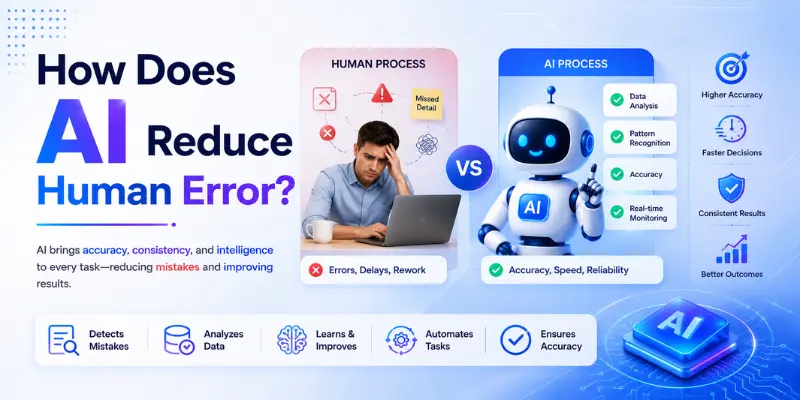
What Is Human Error?
Human error refers to mistakes people make while performing tasks, making decisions, or processing information. These errors can happen for many reasons, including fatigue, stress, lack of attention, limited experience, or poor communication.
Some common examples of human error include:
- Entering incorrect data into a system
- Miscalculating numbers in financial reports
- Missing important details during inspections
- Sending information to the wrong recipient
- Making decisions based on incomplete data
- Forgetting critical steps in a process
Although businesses try to minimize these mistakes through training and quality control, human error remains a major challenge across industries.
How Does AI Reduce Human Error?
Artificial intelligence reduces human error by handling tasks that require speed, consistency, and data analysis. Unlike humans, AI does not get tired, distracted, or affected by emotions. It can process information continuously and follow the same rules every time.
Below are some of the most important ways AI helps reduce mistakes in the workplace and everyday operations.
1. AI Automates Repetitive Tasks
Many workplace errors occur when employees perform the same task repeatedly for long periods. Repetitive work often leads to fatigue and reduced concentration.
AI automation can handle routine activities such as:
- Data entry
- Invoice processing
- Inventory updates
- Appointment scheduling
- Report generation
Because AI follows predefined instructions, it performs these tasks consistently and reduces the likelihood of manual mistakes.
2. AI Improves Data Accuracy
Organizations process large amounts of information every day. Manually reviewing thousands of records increases the risk of incorrect entries and overlooked details.
AI systems can analyze, verify, and organize data much faster than humans while maintaining high levels of accuracy.
For example, banks use AI to review transactions, while businesses use AI-powered analytics tools to identify inconsistencies in large datasets.
3. AI Detects Errors Faster
Finding mistakes manually can take hours or even days. AI systems can scan data in real time and identify unusual patterns almost instantly.
Examples include:
- Detecting fraudulent financial transactions
- Identifying defects in manufacturing products
- Recognizing cybersecurity threats
- Finding inconsistencies in medical records
Early detection allows organizations to fix problems before they become larger and more expensive.
4. AI Reduces Fatigue-Related Mistakes
Humans naturally become tired after working for long periods. Fatigue can affect concentration, memory, and decision-making.
AI does not experience tiredness or loss of focus. It can operate continuously while maintaining the same level of performance.
This makes AI especially valuable in industries that require around-the-clock monitoring, such as healthcare, cybersecurity, and transportation.
5. AI Supports Better Decision-Making
Decision-making often becomes difficult when people must analyze large amounts of information quickly.
AI helps by:
- Analyzing data trends
- Identifying patterns
- Predicting future outcomes
- Providing recommendations
With access to accurate insights, businesses can make more informed decisions and reduce costly errors.
6. AI Provides Real-Time Monitoring
Many industries need continuous monitoring to ensure safety, quality, and efficiency. Humans can miss important details, especially when reviewing large amounts of information for extended periods.
AI continuously monitors systems and instantly identifies unusual activity.
For example:
- Hospitals monitor patient health data
- Factories track machine performance
- Banks monitor financial transactions
- Security teams detect cyber threats
This constant oversight helps organizations prevent problems before they become serious.
7. AI Sends Instant Alerts
Quick action can prevent small issues from becoming major problems. AI systems can immediately notify users when they detect risks or unusual behavior.
Common examples include:
- Fraud alerts in banking
- Equipment failure warnings in factories
- Security breach notifications
- Health monitoring alerts in hospitals
Real-time alerts help businesses respond faster and reduce costly mistakes.
Real-World Examples of AI Reducing Human Error
AI is already helping organizations improve accuracy across many industries.
Healthcare
Doctors and healthcare professionals use AI to analyze medical images, identify abnormalities, and support diagnoses.
Examples include:
- Detecting cancer in medical scans
- Identifying heart conditions
- Monitoring patient health data
AI helps reduce diagnostic errors while supporting healthcare professionals in making informed decisions.
Finance
Banks process millions of transactions every day. Reviewing all of them manually would be nearly impossible.
AI helps by:
- Detecting fraud
- Monitoring suspicious transactions
- Verifying financial records
- Improving risk assessment
This reduces financial errors and improves security.
Manufacturing
Product defects can lead to customer complaints and financial losses.
Manufacturers use AI-powered systems to:
- Inspect products
- Detect defects
- Monitor production lines
- Improve quality control
These systems often identify issues faster than manual inspections.
Transportation
Transportation companies use AI to improve safety and reduce accidents.
Examples include:
- Driver-assistance systems
- Route optimization
- Vehicle monitoring
- Traffic prediction
AI helps drivers make safer decisions and reduces the risk of human mistakes.
Customer Service
Businesses use AI chatbots and virtual assistants to provide accurate and consistent customer support.
AI helps by:
- Answering common questions
- Providing instant responses
- Reducing communication errors
- Improving customer satisfaction
Can AI Completely Eliminate Human Error?
The simple answer is no.
AI can significantly reduce human error, but it cannot eliminate mistakes entirely.
AI systems depend on:
- Data quality
- Training models
- Human instructions
- Software reliability
If the data is inaccurate or the system is poorly designed, AI can also produce incorrect results.
The most effective approach combines human expertise with AI capabilities. Humans provide judgment and creativity, while AI delivers speed, consistency, and analytical support.
Conclusion
Human error is one of the biggest challenges faced by businesses and organizations. Mistakes caused by fatigue, distraction, and manual processes can affect productivity, safety, and profitability.
Artificial intelligence helps reduce these errors by automating repetitive tasks, improving data accuracy, providing real-time monitoring, and supporting better decision-making. From healthcare and finance to manufacturing and transportation, AI is helping organizations achieve higher levels of accuracy and efficiency.
However, AI is not a complete replacement for human intelligence. The best results come when businesses combine human expertise with AI-powered tools. By working together, humans and AI can reduce mistakes, improve productivity, and create better outcomes across a wide range of industries.

- Be Respectful
- Stay Relevant
- Stay Positive
- True Feedback
- Encourage Discussion
- Avoid Spamming
- No Fake News
- Don't Copy-Paste
- No Personal Attacks
- Be Respectful
- Stay Relevant
- Stay Positive
- True Feedback
- Encourage Discussion
- Avoid Spamming
- No Fake News
- Don't Copy-Paste
- No Personal Attacks
