How Does Artificial Intelligence Work?
Published: 27 Jul 2026
Artificial Intelligence (AI) is one of the most powerful technologies in the modern world. People use AI every day, often without even realizing it. From ChatGPT and virtual assistants to Netflix recommendations and self-driving cars, AI has become part of our daily lives.
But have you ever wondered how AI actually works?
Many people think AI works like a human brain, able to think, understand, and make decisions instantly. In reality, AI follows a structured process. It learns from data, identifies patterns, and uses algorithms to make predictions or decisions.
Understanding how artificial intelligence works can help you better understand the technology behind many modern applications and services.
In this guide, you will learn how AI works step by step, the technologies behind it, and real-world examples of AI in action.
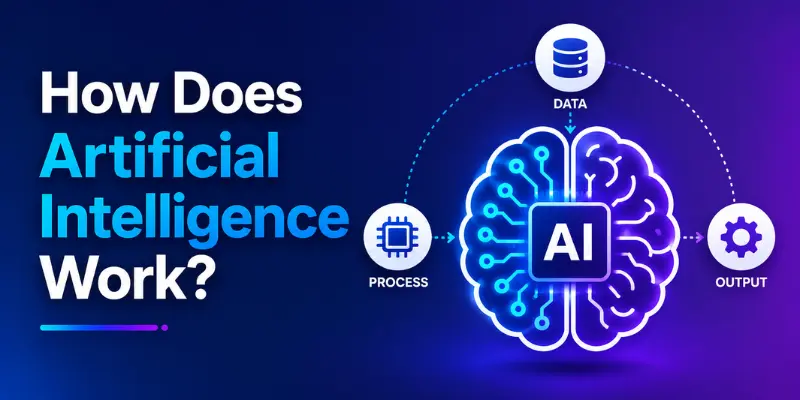
How Does Artificial Intelligence Work Step by Step?
Artificial Intelligence works through a series of steps that allow computers to learn from data, identify patterns, and make decisions. Although the process may seem complex, it can be understood through six simple stages.
1. Data Collection
The first step in AI is collecting data. Data is the foundation of every AI system because AI cannot learn or make decisions without information.
The data can come from many sources, including websites, images, videos, sensors, social media platforms, customer interactions, and business records. For example, if developers want an AI system to recognize cats, they must provide thousands of cat images for training.
Data quality directly affects AI performance. Accurate and relevant data helps the system learn more effectively and produce better results.
2. Data Processing
After data is collected, it must be processed and prepared for analysis. Raw data often contains errors, duplicate information, or irrelevant details that can affect AI performance.
During this stage, the data is cleaned, organized, and converted into a format that AI algorithms can understand. The system may remove unnecessary information, correct errors, and group similar data.
Proper data processing helps improve the accuracy and efficiency of the AI model.
3. Pattern Recognition
Once the data is ready, AI begins analyzing it to identify patterns and relationships. This is one of the most important stages of artificial intelligence.
For example, if an AI system is trained on thousands of photos of dogs, it starts recognizing common features such as fur, ears, eyes, and body shapes. Over time, the system learns which characteristics are associated with dogs and which are not.
Pattern recognition allows AI to understand information and make predictions based on what it has learned.
4. Model Training
After identifying patterns, the AI model enters the training phase. During training, machine learning algorithms repeatedly analyze data and learn from examples.
The AI makes predictions and compares them with the correct answers. If the prediction is wrong, the system adjusts its calculations and tries again. This process continues thousands or even millions of times until the model becomes more accurate.
The goal of training is to teach the AI how to perform a specific task successfully.
5. Decision-Making and Predictions
Once the training process is complete, the AI model can analyze new information and make decisions.
When new data is provided, the system compares it with the patterns learned during training. It then predicts outcomes, recommends actions, or generates responses based on its knowledge.
For example, a streaming platform may recommend movies based on a user’s viewing history, while a fraud detection system may identify suspicious transactions based on previous patterns.
6. Continuous Learning and Improvement
Many modern AI systems continue improving after deployment. As they receive new data, they can refine their models and improve performance.
For example, recommendation systems become more accurate as users interact with them over time. Similarly, AI assistants can provide better responses as they process more information.
Continuous improvement helps AI adapt to changing conditions and remain effective in real-world applications.
Simple Example of How AI Works
Imagine you want to teach an AI system to identify dogs in photos.
- First, thousands of dog images are collected.
- Next, the images are cleaned and organized.
- Then, the AI analyzes the images and identifies common features.
- During training, the system learns which features belong to dogs.
- After training, it can examine a new image and predict whether it contains a dog.
- As more images are added, the AI continues improving its accuracy.
This simple example shows how artificial intelligence learns from data and uses that knowledge to make decisions.
Key Technologies Behind Artificial Intelligence
Several technologies work together to enable AI.
Machine Learning
Machine Learning is a branch of AI that allows computers to learn from data without being explicitly programmed for every task.
It helps AI identify patterns and improve performance through experience.
Deep Learning
Deep Learning is a more advanced form of machine learning.
It uses artificial neural networks to process large amounts of data and solve complex problems.
Many modern AI applications rely on deep learning.
Neural Networks
Neural networks are computer systems inspired by the structure of the human brain.
They help AI analyze information, recognize patterns, and make decisions.
Natural Language Processing (NLP)
Natural Language Processing enables AI to understand and generate human language.
It powers tools such as:
- ChatGPT
- Virtual assistants
- Language translators
- AI chatbots
Computer Vision
Computer Vision allows AI systems to understand images and videos.
This technology is commonly used in:
- Facial recognition
- Medical imaging
- Self-driving cars
- Security systems
Simple Example of How AI Works
Imagine you want an AI system to recognize dogs in photos.
First, developers provide thousands of dog images.
Next, the AI analyzes those images and learns common features such as:
- Ears
- Eyes
- Fur patterns
- Body shapes
During training, the system improves its ability to recognize dogs.
Later, when a new image is uploaded, the AI compares it to what it has learned and predicts whether it contains a dog.
This simple process demonstrates how AI learns from data and applies its knowledge to new situations.
Conclusion
So guys, now you understand how artificial intelligence works clearly. Artificial Intelligence works by collecting data, processing information, identifying patterns, and learning from examples. Using technologies such as machine learning, neural networks, and deep learning, AI can analyze data and make decisions with impressive speed and accuracy.
In 2026, AI is powering everything from chatbots and search engines to healthcare systems and self-driving vehicles. As AI continues to become a bigger part of our daily lives, understanding how it works can help you use these technologies more effectively and stay informed about the future of innovation.
Frequently Asked Questions
AI needs data, algorithms, and computing power to function. These components help the system learn patterns, process information, and make predictions or decisions.
AI can learn from data through machine learning, but it does not learn like humans. It improves its performance by analyzing examples and adjusting its models based on training data.
Common examples include ChatGPT, Siri, Alexa, Netflix recommendations, self-driving cars, fraud detection systems, and healthcare applications.

- Be Respectful
- Stay Relevant
- Stay Positive
- True Feedback
- Encourage Discussion
- Avoid Spamming
- No Fake News
- Don't Copy-Paste
- No Personal Attacks
- Be Respectful
- Stay Relevant
- Stay Positive
- True Feedback
- Encourage Discussion
- Avoid Spamming
- No Fake News
- Don't Copy-Paste
- No Personal Attacks
